[Despite a very busy summer, I also enjoyed a decent slate of summer reading, and will try to catch up a bit on my reading log here.]
Over the last two years my wife has become a devoted fan of Anne Lamott. Like most converts, she also tends to be a bit of a zealot, so I kept trying to more objectively guage just how good Anne Lamott was. While I still haven't gotten around to Traveling Mercies or Plan B, a few weeks ago while we were visiting friends in Atascadero, CA they gave me a copy of Lamott's Bird by Bird: Some Instructions on Writing and Life. I'm sold.
Lamott regularly had me laughing out loud. And if it doesn't sound too hokey, the book really was downright "inspiring." While I could pretty legitimately described as an "author," I still dream of being a "writer," and Lamott's wisdom helped dream myself into that just a little bit more. (Just need to take things "bird by bird.") But on top of the "instructions" side of this book, Lamott offers a number of gems by just being a closer observer, somebody who knows how to pay attention to what's right in front of her.
Perhaps, above all, I find her voice to be without guile. She is an honest writer, and here she is (sometimes brutally) honest about both writing and life.
9.13.2006
8.13.2006
Wine, Interpretation, and "Objectivity"
An interesting piece in the New York Times today takes a hard look at the rise of the 100-point system for rating wine--tracing its history from Robert Parker's Wine Advocate to its industry-wide adoption--but also calling into question it's effectiveness. Even those who employ the system grant that it gives an air of scientificity and objectivity to something that is much slipperier and elusive. Judging wine (like hermeneutics and interpretation) is an art, not a science--though even the best art should be informed by good theory and criteria, as well as apprenticeship and training.
Perhaps most disheartening is the market-driven nature of the 100-point system and the challenges of conflict of interest when ratings are doled out by glossy magazines laced with ads from the wineries and producers subject to their judgment (as well as retailers who post those little scoring tags below the bottle displays). And while some mags commit [or claim to commit] to "blind" tasting, there's still a problem similar to peer-review in the academy: vintners have figured out what these folks like, and produce wines that are primed to score well--which is a bit like the tail wagging the dog.
The upshot? A few years ago, I read Jim Flick's book on golf, which recommended that most people should resist the hype of massive, ballooned 1-woods, just leave their drivers at home, play from the tee with a trusty 3-wood. Perhaps something of the same is true for new wine afficianados: Amateurs might do better to ignore the pseudo-science of scores and the mass-market formulas the system has spawned and, instead, trust the friendly, knowledgeable folks at a local wine shop.
Perhaps most disheartening is the market-driven nature of the 100-point system and the challenges of conflict of interest when ratings are doled out by glossy magazines laced with ads from the wineries and producers subject to their judgment (as well as retailers who post those little scoring tags below the bottle displays). And while some mags commit [or claim to commit] to "blind" tasting, there's still a problem similar to peer-review in the academy: vintners have figured out what these folks like, and produce wines that are primed to score well--which is a bit like the tail wagging the dog.
The upshot? A few years ago, I read Jim Flick's book on golf, which recommended that most people should resist the hype of massive, ballooned 1-woods, just leave their drivers at home, play from the tee with a trusty 3-wood. Perhaps something of the same is true for new wine afficianados: Amateurs might do better to ignore the pseudo-science of scores and the mass-market formulas the system has spawned and, instead, trust the friendly, knowledgeable folks at a local wine shop.


8.03.2006
A Tale of Two Religions?
I had to hastily finish Michael Ruse's wonderful book The Creation-Evolution Struggle because it's due back to the public library. But it will repay a second loan. Ruse, a philosopher by training, has here written a bit of a page-turner history of the emergence of evolutionary theory and the ensuing debates and clash with religion--particularly creationism and intelligent design.
Ruse is eminently fair to both sides, without pulling any punches. It's particularly interesting to find a non-Christian scholar (Ruse variously describes himself as a "deist" and an "agnostic") who recognizes the long history of how legitimate evolutionary science is regularly morphed into a kind of secular religion. Ruse distinguishes these with the rubric of "evolution" or "evolutionary science" vs. "evolutionism"--the latter being the equivalent of a "secular religion." Ruse is at pains to argue that evolution did not necessarily entail evolutionism; but nevertheless, contingently and historically it did and has regularly yielded the latter.
Curiously, Ruse the philosopher here avoids properly philosohical questions (e.g., the epistemic conditions of "science," etc.), but he has addressed those questions elsewhere. This book provides an excellent history of the emergence of evolutionary theory and should be required reading for anyone interested in these questions.
Ruse is eminently fair to both sides, without pulling any punches. It's particularly interesting to find a non-Christian scholar (Ruse variously describes himself as a "deist" and an "agnostic") who recognizes the long history of how legitimate evolutionary science is regularly morphed into a kind of secular religion. Ruse distinguishes these with the rubric of "evolution" or "evolutionary science" vs. "evolutionism"--the latter being the equivalent of a "secular religion." Ruse is at pains to argue that evolution did not necessarily entail evolutionism; but nevertheless, contingently and historically it did and has regularly yielded the latter.
Curiously, Ruse the philosopher here avoids properly philosohical questions (e.g., the epistemic conditions of "science," etc.), but he has addressed those questions elsewhere. This book provides an excellent history of the emergence of evolutionary theory and should be required reading for anyone interested in these questions.
7.24.2006
How We'll Read: The Future of the Book?
It would seem that the news of the death of the book has been a bit premature. While both prophets of doom and heralds of "progress" have been penning requiems for the book since the 1970s (sometimes falsely referring to Derrida's discussion of the "end of the book" in Of Grammatology), people still don't crawl into bed with Adobe eReaders and such.
However, a fascinating article in the Chronicle of Higher Education discussed some new initiatives in academic publishing: "Book 2.0" explores some projects related to the "Institute for the Future of the Book." While I'll never give up the tangibility of treasured hold-in-your-hand volumes of paper, I can see some interesting possibilities here for unique collaborative scholarship. Be sure to follow the links to "experience" the future of the book.
However, a fascinating article in the Chronicle of Higher Education discussed some new initiatives in academic publishing: "Book 2.0" explores some projects related to the "Institute for the Future of the Book." While I'll never give up the tangibility of treasured hold-in-your-hand volumes of paper, I can see some interesting possibilities here for unique collaborative scholarship. Be sure to follow the links to "experience" the future of the book.
6.13.2006
(Another) American in Paris
Continuing an American tradition that goes back to Hemingway--and even earlier, as Franklin and Jefferson were regular haunts of the city--Adam Gopnik's Paris to the Moon is a memoir that narrates the five-year adventure of an American (and Canadian ex-pat) in Paris (1995-2000) with his wife, young son (and later a daughter that was the fruit of their time in the City of Light). This is one of those books that have been on my "to read" list since it was first released, but never made it onto the nightstand--due in no small part, I think, to just sheer jealousy. Gopnik was living the (my!) dream.
Making a commitment to reside in Paris, this isn't just another travelogue--though a persistent theme of the book is just how much he feels continues to feel like an outsider. The closest he ever feels to being an "insider" is when he becomes part of a protest group committed to keeping open a local restaurant in danger of being gobbled up by the homogenizing forces of globalizing cuisine. Connoisseurs of the world unite! But in the midst of their sit-in protest, Gopnik sees a problem with the revolution:
Gopnik's pen is agile and tender, issuing in a flourish of similies ("Alice had found frisee and watercress and was looking at them raptly--not with the greed of a hungry man seeing dinner but with the admiration of William Bennett looking at a long marriage," p. 244) as well as on-the-money "capturings" of experience. My favorite in the latter category is when he describes storytime with his son, in the late evening:
As is usual--one finds this alot with students who study abroad--the cross-cultural experience makes possible a reflection on one's own culture that wouldn't be possible otherwise. As Gopnik observes, "There are certain insights that can come to an American only when is abroad, because only there does the endless ribbon of American television become segmented enough so that you can pay attention to its parts," for instance. Gopnik is at his best in this mode of Paris-based reflection on American culture in his chapter "Barney in Paris" (yes, that Barney!) and some reflections on football (soccer) by a lover of baseball and hockey.
Gopnik's prose had so welcomed me into his world that I, too, felt the sting of his family's departure for Paris, just as I felt a sting of disappointment in the book's coming to an end.
Making a commitment to reside in Paris, this isn't just another travelogue--though a persistent theme of the book is just how much he feels continues to feel like an outsider. The closest he ever feels to being an "insider" is when he becomes part of a protest group committed to keeping open a local restaurant in danger of being gobbled up by the homogenizing forces of globalizing cuisine. Connoisseurs of the world unite! But in the midst of their sit-in protest, Gopnik sees a problem with the revolution:
We were building up to an impressive pitch of indignation, but at that point the waiters began to serve the dinners that we had ordered while we were waiting to begin our protest, and this weakened the revolutionary spirit a little. There was, I sensed, a flaw in our strategy: If you take over a restaurant as an act of protest and then order dinner at the restaurant, what you have actually done is gone to the restaurant and had dinner, since a restaurant is, by definition, always occupied, by its diners. Having come to say that you just won't take it anymore, you have to add sheepishly that you will take it, au point and with bearnaise sauce.The book is witty and warm, while also having the rather pedestrian virtue of being informative. Gopnik's chapters on French cuisine and couture are some of the best in the book for the way they respectfully and charitably peel back the layers of Paris for foreign eyes. His chronicles of the adventures of navigating French bureaucracy seethe with frustration, while the annals of a daily life lived in tiny, banal rituals provide a sense of the depth of the world. In these descriptions, the mundane habits of a walk in the park are seen as portals to hidden worlds--as if worlds upon worlds were tucked away in corners of the Luxembourg Gardens (found especially in the chapters that constitute his annual "Christmas Journals"--Journal 3, "Lessons from Things," being the best of the bunch).
Gopnik's pen is agile and tender, issuing in a flourish of similies ("Alice had found frisee and watercress and was looking at them raptly--not with the greed of a hungry man seeing dinner but with the admiration of William Bennett looking at a long marriage," p. 244) as well as on-the-money "capturings" of experience. My favorite in the latter category is when he describes storytime with his son, in the late evening:
Paris is a northern city, on a latitude with Newfoundland, as New York is a Mediterranean one, on a latitude with Naples, and so the light here in the hours between seven and nine at night is like the light in the hours between five and seven in New York. The sun is still out, but the sounds have become less purposeful--you hear smaller noises, high heels on the pavement--and though it is a pleasant time to lie in bed, it is not an easy time for a small boy to go to sleep (pp. 196-197).The conjunction of light and sound, and the playful suggestion that the bend of the sun somehow dulls the air through which sound travels, crystallizes in the "high heels on the pavement" observation, which transports one to just that kind of evening and sound. Great stuff.
As is usual--one finds this alot with students who study abroad--the cross-cultural experience makes possible a reflection on one's own culture that wouldn't be possible otherwise. As Gopnik observes, "There are certain insights that can come to an American only when is abroad, because only there does the endless ribbon of American television become segmented enough so that you can pay attention to its parts," for instance. Gopnik is at his best in this mode of Paris-based reflection on American culture in his chapter "Barney in Paris" (yes, that Barney!) and some reflections on football (soccer) by a lover of baseball and hockey.
Gopnik's prose had so welcomed me into his world that I, too, felt the sting of his family's departure for Paris, just as I felt a sting of disappointment in the book's coming to an end.
5.14.2006
Best American Fiction?
The New York Times has an interesting piece on the best American fiction of the last 25 years. (For the implicit criteria, see the list of judges.) Toni Morrison's Beloved was the winner, and Don DeLillo's Underworld was runner-up (I don't think you'll see that one on Oprah's book club.) I'm not a huge fan of American fiction, but I do love Updike, and glad to see the Rabbit novels get honorary mention. And I just keep bumping into the nihilism of Cormac McCarthy everywhere, including a recent Harper's piece. Need to add his trilogy to my summer reading list.
5.13.2006
"Grace is Everywhere"
Those, like me, who enjoyed Marilynne Robinson’s Gilead will undoubtedly be moved by Georges Bernanos’ classic, The Diary of a Country Priest (first published in 1937), which I finished on the plane to Geneva. Indeed, one wonders if Robinson didn’t find a certain inspiration and model in Bernanos’ novel: Robinson gives us a glimpse into the epistolary legacy left by a dying old Reformed preacher in the rural American Midwest; Bernanos steals for us the diary of an ailing young Catholic priest tending a tiny parish in the French countryside.
The Diary is typically French: only about six things ever happen in the book. But the genius of the book is the anonymous priest’s keen observatory powers, turned on both his parish and friends, and turned inward in introspection. All of this is interlaced with brilliant literary theological reflection which seems to capture the spirit (I would say) of le nouvelle théologie. (E.g., the priest remarks: “Paganism was no enemy of nature, but Christianity alone can exalt it, can raise it to man’s own height, to the peak of his dreams.”)
His is an honest faith: grappling with doubt, and yet so strongly tethered to Christ; struggling with prayer, and yet a life bathed in prayer; looking for friendship, and finding it in the most unexpected places; loathing, but loving, his parishioners; frustrated by the institutional church, but not abandoning it. Above all, Bernanos illuminates the sacramentality of the world in the priest’s final words: “Grace is everywhere.”
The Diary is typically French: only about six things ever happen in the book. But the genius of the book is the anonymous priest’s keen observatory powers, turned on both his parish and friends, and turned inward in introspection. All of this is interlaced with brilliant literary theological reflection which seems to capture the spirit (I would say) of le nouvelle théologie. (E.g., the priest remarks: “Paganism was no enemy of nature, but Christianity alone can exalt it, can raise it to man’s own height, to the peak of his dreams.”)
His is an honest faith: grappling with doubt, and yet so strongly tethered to Christ; struggling with prayer, and yet a life bathed in prayer; looking for friendship, and finding it in the most unexpected places; loathing, but loving, his parishioners; frustrated by the institutional church, but not abandoning it. Above all, Bernanos illuminates the sacramentality of the world in the priest’s final words: “Grace is everywhere.”
4.13.2006
Laughing all the way to the Wodehouse
I just enjoyed the cathartic pleasures of some laugh-out-loud, tears-rolling-down humor in P.G. Wodehouse’s tales of Bertie Wooster and Jeeves--in a wonderful collection of Wodehouse’s witty short stories, The Most of P.G. Wodehouse (Scribner, 2000), which I picked up in Chicago a few weeks ago. A delightful change of pace from more sober reading of late.
Thinking back, I was put onto Wodehouse by two quite different trajectories that both intersect in Evelyn Waugh. The first was via Christopher Hitchens who, in Love, Poverty, and War, comments on both Waugh and Wodehouse. The second avenue was through the leads provided by George Weigel’s Letters to a Young Catholic, which also put me onto Waugh. Then, a couple months ago, on a gorgeous Saturday in early March, I sauntered over to a local used book shop (All the King’s Books) and found a wonderful collection on Waugh (Evelyn Waugh and His World, edited by David Pryce-Jones), which made several mentions of Wodehouse, including reference to Waugh’s defense of Woodhouse in the Times (16 July 1961). So when I ran into this Wodehouse collection in Chicago (and for a bargain!), it seemed as if Evelyn had led me to the spot. Tonight’s read was the pay-off.
Thinking back, I was put onto Wodehouse by two quite different trajectories that both intersect in Evelyn Waugh. The first was via Christopher Hitchens who, in Love, Poverty, and War, comments on both Waugh and Wodehouse. The second avenue was through the leads provided by George Weigel’s Letters to a Young Catholic, which also put me onto Waugh. Then, a couple months ago, on a gorgeous Saturday in early March, I sauntered over to a local used book shop (All the King’s Books) and found a wonderful collection on Waugh (Evelyn Waugh and His World, edited by David Pryce-Jones), which made several mentions of Wodehouse, including reference to Waugh’s defense of Woodhouse in the Times (16 July 1961). So when I ran into this Wodehouse collection in Chicago (and for a bargain!), it seemed as if Evelyn had led me to the spot. Tonight’s read was the pay-off.
4.03.2006
A Poem a Day
I'm enjoying a service that Knopf is providing as part of Poetry Month. Their "Poem-a-Day" list brings new poetry to your inbox each day--including both new voices and old favorites. Included are also podcasts of poem readings. For instance, today was a double treat: Joan Didion reading Gerard Manley Hopkins!
Amidst the administrative drudgery that constitutes most of my inbox, these little missives are like little in-breakings of grace from another world. Consider treating yourself to the same: subscription is free.
Amidst the administrative drudgery that constitutes most of my inbox, these little missives are like little in-breakings of grace from another world. Consider treating yourself to the same: subscription is free.
2.25.2006
John Paul II: A Call to Bishops
I just finished reading John Paul II's Rise, Let Us Be On Our Way (Warner Books, 2004)--a letter, of sorts, to fellow bishops. A quick and easy read, interesting both for matters of biography (the book roughly tracks the period after Wojtyla's ordination, focusing on his appointment as an auxilary bishop then bishop in Poland) and for reflections on the nature of the church, priesthood, and episcopate. It is also an invitation into the friendships that were so crucial to JP II's ministry (the array of Polish names gets pretty overwhelming). Especially interesting is the former Pope's discussion of his involvement with Vatican II, and then his task as bishop to "implement" the Council. Citing the importance of de Lubac for his thought, one finds in John Paul II's vision the kind of ancient-future sensibility which is able to think both ressourcement and aggiornamento. As he puts it near the end of the book (p. 213):
While I continue to be nonplussed by JP II's tendency toward nationalisms and his friendliness to liberalism and capitalism (I can now see that this emerges from his experience with the atrocities of both the Nazis and Communists), this vision of an ancient-future Catholic faith that is unafraid to articulate a vision of the world to the world resonates deeply.
Our faith, our responsibility and our courage are all necessary if Christ's gift is to manifest itself to the world in all its splendor. Not just the kind of faith that safeguards and keeps intact the treasure of God's mysteries, but a faith that has the courage to open and reveal this treasure in constantly new ways to those to whom Christ sends His disciples. And not just the kind of responsibility that limits itself to defending what has been handed down, but the kind that has the courage to use its talents and multiply them.
While I continue to be nonplussed by JP II's tendency toward nationalisms and his friendliness to liberalism and capitalism (I can now see that this emerges from his experience with the atrocities of both the Nazis and Communists), this vision of an ancient-future Catholic faith that is unafraid to articulate a vision of the world to the world resonates deeply.
1.17.2006
Top 5 of 2005: Much Belated
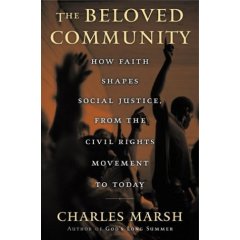 A while back I promised to post my top 5 books of 2005. We're now a long ways from end-of-year recollections, but I'll try to make good on the promise. I don't mean this to be an "objective" list of the best books from last year (as Napolean replied to Kit: "Like anyone could even know that!"). Rather, they're five books that stick out in my memory of a year of reading.
1. Charles Marsh, The Beloved Community: How Faith Shapes Social Justice, From the Civil Rights Movement to Today. Hands down, my favorite book of 2005, and one of the best books I've read in a long time. Marsh does an excellent job rescuing the civil rights movement from liberalism and demonstrating its thick connections to the particularities of the worshipping community. Because of its ecclesiocentric roots, Marsh evaluates the "secularization" of the civil rights movement not as its completion, but rather as precisely that which stunted its effects. This book is also a model of "public" theological writing--that is, theology undertaken as public intellectual discourse without sacrificing the rigor of theological confession and precision. I can't speak highly enough about Marsh's accomplishment.
2. Alan Jacobs, The Narnian: The Life and Imagination of C.S. Lewis. This was an end-of-year treat for me. Jacobs navigates a course between hagiography (all too common in Lewis literature) and cynicism (think A.N. Wilson). It is a solid intellectual biography that helpfully explores interesting tensions in Lewis (particularly the intra-psychic tensions between the worlds of philosophy and literature, logic and fantasy), as well as several curious snippets about Lewis' interest in sado-masochism [that doesn't show up in the hagiographies]. The end of the book felt a little rushed (the movie release date approaching?), but throughout I particularly enjoyed Jacobs' account of "Faery" as central to Lewis' thought. An enjoyable read.
3. Nicole Krauss, The History of Love. As I noted earlier on this blog, a wonderful literary novel.
4. Creston Davis, John Milbank, and Slavoj Zizek, editors, Theology and the Political. This is the only "academic" book I'll include, but I think it is a landmark volume on the boundaries of philosophy, theology, ontology, and politics. It will take a year to digest it all.
5. George Weigel, The Cube and the Cathedral: Europe, America, and Politics Without God. I continue to feel an allergy to Weigel's (Constantinian) politics and (basically neo-con) economic leanings, and yet I find myself often in deep agreement with his diagnoses of what's wrong with the West (in which he echoes much of Benedict XVI's own diagnoses). This book offers a compelling contrast between the poverty of European liberalism and the richness of Catholic social thought.
1.11.2006
The Revival of Biography

Since Christmas vacation I've been treating myself to reading some biographies, including Alan Jacobs' The Narnian: The Life and Imagination of C.S. Lewis [more on that in a later post] and a little gem I found at a local used bookshop: Dennis Donoghue's Walter Pater: Lover of Strange Souls.
But it's another little biography that is the occasion for my post: Edmund White's Marcel Proust in The Penguin Lives Series. Or perhaps I should say it is the series itself which has intrigued me--akin to Harper Collins Eminent Lives Series, from which I read Christopher Hitchens on Thomas Jefferson this past summer. These biography series often have a brilliant alchemy, creating a way to bring together potent contemporary voices to produce dense--or rather, economical--portraits of historical figures in ways that are both illuminating and literary. One might hope this represents a renewed place for biography that might finally displace the incessant string of memoirs from twentysomethings! And if they represent a certain rennaissance of biography, one wonders how short the cycle must be, since Evelyn Waugh--in his own 1928 biography of D.G. Rossetti that very much fits this genre--opened by noting:
Biography, as books about the dead are capriciously catalogued, is still very much in the mode.He goes on to, shall we say, confess?--
It has usurped the place held in recent years by the novel, and before that by poetry, as the regular metier of all those young men and women who, in every age, concern themselves with providing the light reading of their more cultured friends. Naturally enough, a new manner has resulted, and, to a great extent, a new method; and polite literature is the less polite for it.
We have discovered a jollier way of honoring our dead. The corpse has become the marionnette. With bells on its fingers and wires on its toes it is jigged about to a "period dance" of our own piping; and who is not amused? Unfortunately, there is singularly little fun to be got out of Rossetti. (Waugh, Rossetti: His Life and Works, 1928, pp. 11-12)I take it that Waugh worries that the entertainments of these "Lives" can create anachronistic creations for our own delight--a kind of horizontal Feuerbachian worry that we'll create our subjects in our own image. Fair enough; and in fact, White's little life of Proust probably does just that with its incessant fixation on Proust's homosexuality. And yet, there is an invitation to other worlds embedded in here from which it is always a bit disappointing to have to return.
12.31.2005
Sights and Sounds: Brideshead Revisited
Before our longish drive back to Canada for Christmas vacation, I set off to our public library in search of a book on CD with hopes of shortening the trip, as it were. I hit upon a gem: Evelyn Waugh's Brideshead Revisited narrated by Jeremy Irons. This turned out to be a spectacular combination. Irons--who, for me, will almost simply be identified with Father Gabriel in The Mission--brings Waugh's very Catholic novel to life in wonderful ways. With a voice much at home on the stage, Irons incarnates Waugh's already remarkably complex and charming characters, creating voices for each (even the 11-year-old girl, Cordelia), and hitting just the right note for Charles Ryder's narrative voice.
But then another wonderful little turn of providence. Our pilgrimage back to family in Canada always takes us to Stratford, Ontario--effectively our hometown (though we're from small villages just south), namesake for Stratford-upon-Avon, and home to the acclaimed Stratford Festival Theatre. All in all, an absolutely charming place that everyone should try to visit at least once. One of the treats of visiting Stratford is returning to some old haunts in local bookshops, particularly two used bookshops from which I've built some important parts of my library. My favorite is The Book Stage, just behind the Avon Theatre and run by a German bibliophile, Manfred Meurer (who does not lack resemblance to Albert Einstein). Manfred and I developed something of a working relationship as I was engaged in graduate studies in phenomenology--first in Toronto, then in Philadelphia. As Manfred learned of my work and interests, and watched my book-buying habits, he started to set aside texts for me in a secret little closet, to be unveiled whenever I returned to Stratford. When I would come back into town from Philadelphia, I would visit Manfred, who would then trot out assorted Husserl and Heidegger books, some even in German. I think he was almost as excited as I was.
Alas, Manfred closes up shop for the winters, so I headed to my other haunt: "Yesterday's Things," a used book shop on Ontario Street just a few doors down from our first apartment after returning from Iowa. (It was a charming space: a second floor flat in a turn-of-the-century home; it will always be remembered as the home to which we brought our firstborn, Grayson.) The philosophy and theology selection at Yesterday's Things does not compare to Manfred's (think multiple copies of A Course in Miracles), but the literature selection is outstanding--and incredibly inexpensive (especially when the American dollar is a little stronger). I first headed to the Wilde section, but found nothing I don't already own. There was a decent edition of Orwell's later journalism and letters, but in paperback. No Chesterton. A volume of C.S. Lewis's letters looked intriguing. But then I noticed, on top of the shelves and out of order, a mint, hardcover edition of Waugh's Brideshead Revisited--a Little, Brown edition from 1979 for just $10 (CDN!). I snapped it up.
I continued to listen to Irons' rendition on the way back to the States, and now back home (and with very little time in the car), I've turned to reading the hard copy. I'm not sure if it is unfortunate or fortunate, but Ryder's narrative voice-in-my-head while I read is Irons', and Irons' wonderful interpretation of the characters continues to echo for me (his rendering of Anthony is spot on). And as new characters come on the scene, I half find myself tempted to hear how Irons plays them out, and perhaps I'll give in to the temptation and check. In any case, Irons' performance of the book has enriched my reading--as if I can hear the book in my hands.
But then another wonderful little turn of providence. Our pilgrimage back to family in Canada always takes us to Stratford, Ontario--effectively our hometown (though we're from small villages just south), namesake for Stratford-upon-Avon, and home to the acclaimed Stratford Festival Theatre. All in all, an absolutely charming place that everyone should try to visit at least once. One of the treats of visiting Stratford is returning to some old haunts in local bookshops, particularly two used bookshops from which I've built some important parts of my library. My favorite is The Book Stage, just behind the Avon Theatre and run by a German bibliophile, Manfred Meurer (who does not lack resemblance to Albert Einstein). Manfred and I developed something of a working relationship as I was engaged in graduate studies in phenomenology--first in Toronto, then in Philadelphia. As Manfred learned of my work and interests, and watched my book-buying habits, he started to set aside texts for me in a secret little closet, to be unveiled whenever I returned to Stratford. When I would come back into town from Philadelphia, I would visit Manfred, who would then trot out assorted Husserl and Heidegger books, some even in German. I think he was almost as excited as I was.
Alas, Manfred closes up shop for the winters, so I headed to my other haunt: "Yesterday's Things," a used book shop on Ontario Street just a few doors down from our first apartment after returning from Iowa. (It was a charming space: a second floor flat in a turn-of-the-century home; it will always be remembered as the home to which we brought our firstborn, Grayson.) The philosophy and theology selection at Yesterday's Things does not compare to Manfred's (think multiple copies of A Course in Miracles), but the literature selection is outstanding--and incredibly inexpensive (especially when the American dollar is a little stronger). I first headed to the Wilde section, but found nothing I don't already own. There was a decent edition of Orwell's later journalism and letters, but in paperback. No Chesterton. A volume of C.S. Lewis's letters looked intriguing. But then I noticed, on top of the shelves and out of order, a mint, hardcover edition of Waugh's Brideshead Revisited--a Little, Brown edition from 1979 for just $10 (CDN!). I snapped it up.
I continued to listen to Irons' rendition on the way back to the States, and now back home (and with very little time in the car), I've turned to reading the hard copy. I'm not sure if it is unfortunate or fortunate, but Ryder's narrative voice-in-my-head while I read is Irons', and Irons' wonderful interpretation of the characters continues to echo for me (his rendering of Anthony is spot on). And as new characters come on the scene, I half find myself tempted to hear how Irons plays them out, and perhaps I'll give in to the temptation and check. In any case, Irons' performance of the book has enriched my reading--as if I can hear the book in my hands.
12.21.2005
Coming Soon: Top 5 of 2005
I've always been a sucker for year-end retrospectives and so the next couple of weeks are always a highlight for me as all kinds of venues generate their "top 10" lists. (See, for instance, the NYT's 10 Best Books of 2005, o John Wilson's Top 10 Books of 2005 from Books & Culture.) I'm going to be more humble and suggest a "Top 5 of 2005" in the next few days. Stay tuned.
12.12.2005
The History of Love
 My wife and I just finished Nicole Krauss's remarkable novel, The History of Love. My wife first devoured it, and when she quite quickly and decisively described it as perhaps her favorite book ever (and she doesn't just say this everyday), I splurged, bought the book, and also proceeded to inhale it from the first lines ("When they write my obituary. Tomorrow. Or the next day. It will say, LEO GURSKY IS SURVIVED BY AN APARTMENT FULL OF SHIT.")
 Krauss's writing is dynamic, with a wide range. There's no monotone rut of observation. Instead, she manages to inhabit several very diverse characters (how does a 34-year-old write so well in the voice of an old man?). The novel has embedded within it several different genres, and layers upon layers (books within books and translations of books, with journals and letter and poems interspersed). And while it is certainly a meditation on love (both familial and romantic, love lost and love hoped-for), it is also a profound exploration of language and all of our attempts to find "words for everything." The book's impact hovers somewhere between ecstacy and mourning, rapture and heartbreak. And it's a book that keeps haunting you for a while. A must read.
11.29.2005
New Left Review: Best Read with Wine
As I think I've confessed before, I'm a journal and magazine junkie. One of my favorite, more 'highbrow' periodicals (without quite being "academic"), is the New Left Review. Each issue always has a few gems, such as Alain Badiou's recent overview of French philosophy, Malcolm Bull's quasi-review of Hardt & Negri's Multitude, Slavoj Zizek's critique of human rights, or Regis Debray's reflections on John Paul II. One of my favorites from a little further back is Mike Davis' chilling account of urban poverty in "Planet of the Slums" (a bit of a precis of his forthcoming book).
And what better way to enjoy reading the New Left Review than with a nice glass of wine? My wife and I have become devoted fans of Riesling, and so I scarfed up the latest issue of the Wine Spectator in which Riesling gets cover story billing. They highlights top Rieslings from Germany, Alsace (in France), Australia, and a few from the States (from Washington and the Finger Lakes region of NY). Our tastebuds are probably a little skewed by our geography, but we thought our favorite Riesling from Chateau Grand Traverse in Michigan deserved a mention!
And what better way to enjoy reading the New Left Review than with a nice glass of wine? My wife and I have become devoted fans of Riesling, and so I scarfed up the latest issue of the Wine Spectator in which Riesling gets cover story billing. They highlights top Rieslings from Germany, Alsace (in France), Australia, and a few from the States (from Washington and the Finger Lakes region of NY). Our tastebuds are probably a little skewed by our geography, but we thought our favorite Riesling from Chateau Grand Traverse in Michigan deserved a mention!
11.07.2005
Calvin e-Journal: Minds in the Making
Nathan Bierma, a relatively new (though returning) face here at Calvin College, was recently appointed the editor of Calvin's web-based zine/mag/journal Minds in the Making. Nathan is one of those people who seems to be doing a hundred different things, and he does them all well! (Nathan is also an author, writes a column for the Chicago Tribune, and now plays a key role at the Calvin Institute of Christian Worship.) His tranformation of the Minds journal if fabulous. In addition to instituting some regular "columns," he regularly collects a wide sampling of some of the intellectually stimulating stuff that happens on our campus almost everyday. And he's done so in a multi-media format, including not only articles and essays, but also audio files of lectures and interviews, as well as visual slides, and more.
Minds in the Making is a wonderful glimpse into the diverse conversations that take place here at Calvin, and we have Nathan to thank for opening the window into that.
Minds in the Making is a wonderful glimpse into the diverse conversations that take place here at Calvin, and we have Nathan to thank for opening the window into that.
10.25.2005
A Reply from Vanity Fair
I have earlier confessed on this blog to my weakness for Vanity Fair. Several months ago (July 28 to be exact), I moved from passive voyeur status and sent the following "Letter to the Editor" to Vanity Fair:
One can hope.
Did the VF editorial team miss the chance to read James Wolcott's article ("To Live and Die in Iraq," August 2005)? In the same article that Wolcott rightly scolds "Mr. Media" for showing only American players in Iraq, and only sanitized images at that, the only photos that accompany the article feature, you guessed it, only American soldiers and none that would disturb Mr. Media's picture of the war. Not a single Iraqi "extra" makes an appearance. Left on the cutting room floor, I guess?
Wolcott's article also catalogues the litany of celebrity "events" that consume American media. And then immediately after his article, I have to endure Dominick Dunne's sophmoric romp through recent Hollywood "disasters." This is amplified by the editorial choice to highlight the line about Lana Clarkson's breasts, with the frat-boy touch of highlighting the word "breasts" in red.To my surprise, I just received this response in reply:
If only VF's editorial policies followed more closely James Wolcott's prescriptions.
James K.A. Smith
Grand Rapids, Michigan
Thank you very much for your letter to the editor. We have received several letters regarding this matter, and I will be sure to address this point with the appropriate editors here. I appreciate your input and hope that you continue expressing your opinions to Vanity Fair.
Sincerely,
Graydon Carter
One can hope.
10.12.2005
Hot off the press: Radical Orthodoxy and the Reformed Tradition
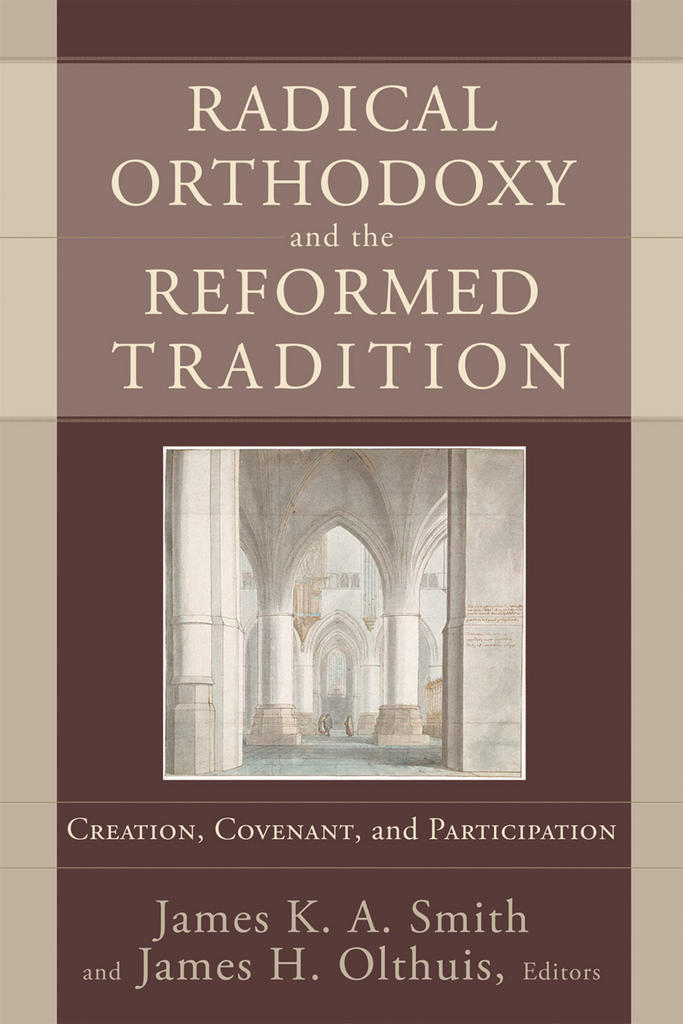
It's a bit weird to suggest that I'm reading my own book, but anyone who's an author knows that, in fact, this is strangely true, without being as utterly vain as it sounds. This week I received the first copies of Radical Orthodoxy and the Reformed Tradition, hot off the press from Baker Academic. After a book has been put to bed (about 6 months prior to its appearance), it's always fun for an author to receive it back in this new form. It sometimes feels like someone else's book, and in the case of an edited collection like this, much of it is!
I was honored by the recent blog attention given the book by an astute reader: Byron Borger of Hearts&Minds Books in PA.
10.06.2005
Listening as Reading
This blog is supposed to keep some notes on what I'm reading; I'm stretching that a little by noting something I'm listening to, which then got me to reading the lyrics. One of my son's friends turned me on to The Decemberists. They're song "16 Military Wives" is quite a remarkable little piece of cultural critique which masks itself as a "ditty" with a kind of upbeat tune which should create serious cognitive dissonance for anyone who listens to the words. I'll paste the lyrics here, but you really must listen to the song. (For some commentary on the "meaning," visit http://www.songmeanings.net/lyric.php?lid=3530822107858533163 .)
Artists > Decemberists, The > Sixteen Military Wives
Submitted by themunkel on March 1, 2005
sixteen military wives
thirty-two softly-focused, brightly-colored eyes
staring at the natural tan
of thirty-two gently clenching,
wrinkled little hands
seventeen company men
out of which only twelve will make it back again.
sergeant sends a letter to five military wives,
his tears drip down from ten little eyes.
cheer them on to their rivals
cause america can
and america can't say no
and america does if
america says it's so
it's so
and the anchorperson on tv
goes la-di-da-di-da.
fifteen celebrity minds
leading their fifteen sordid, wretched checkered lives
will they find their solution in time?
using fifteen pristine moderate liberal minds
eighteen academy chairs, out of which only seven really even care
doling out a garland to five
celebrity minds
they're humbly taken by surprise
cheer them on to their rivals
cause america can
and america can't say no
and america does if
america says it's so
it's so
and the anchorperson on tv
goes la-di-da-di-da-didi-didi-da
la-di-da-di-da-didi-didi-da
fourteen cannibal kings
wondering blithely what the dinner bell will bring
fifteen celebrity minds served in a leafy bed of sixteen military wives
cheer them on to their rivals
cause america can
and america can't say no
and america does if
america says it's so
it's so
and the anchorperson on tv
goes la-di-da-di-da-didi-didi-da.
la-di-da-di-da-didi-didi-da.
10.05.2005
Book Reviews as Crucial Knowledge
[Sorry for the blog silence of late. What little time and energy I've had left for blogging has gone into some discussions at the Generous Orthodoxy "Think Tank."]
I am a passionate devotee of book reviews: I commit to writing quite a few of them, and I make a point of trying to consume them regularly--both the sorts of reviews one finds in the Atlantic and Harper's, as well as the more scholarly review in academic journals. [For the latter, the "table of contents alert services" that many academic journals provide are a godsend. See the Modern Theology site for an example, and click on "Sign-up for e-tocs."]
I think book reviews are a crucial arena for discourse, for both "public" intellectuals and the ivory halls of academe. Sometimes they are pointers, bringing to our attention works that we might not otherwise have encounters; at other times, they provide an arena for debate and provide an opportunity to "listen in" as leading thinkers hash out their commonalities and differences. And there's nothing an author likes more than a good book review (where "good" doesn't just mean praise and adulation, but rather someone who really takes your arguments seriously, thinks along with you, and then takes you places you didn't go in the book).
One rich and free resource that I highly recommend is Notre Dame Philosophical Reviews. A relatively new online review, the editors manage to get some of the best people in philosophy to provide very extensive reviews of works across a range of subdisciplines and even across the disciplines. Sign-up to receive new reviews by email and you'll receive several treasures weekly and browse through the Archives to find much more.
Today I received a review of a fascinating book I hadn't come across: Amy Mullins' Reconceiving Pregnancy and Childcare. This is one of the briefer NDPR reviews, but has got me to put this book on my wish list.
I am a passionate devotee of book reviews: I commit to writing quite a few of them, and I make a point of trying to consume them regularly--both the sorts of reviews one finds in the Atlantic and Harper's, as well as the more scholarly review in academic journals. [For the latter, the "table of contents alert services" that many academic journals provide are a godsend. See the Modern Theology site for an example, and click on "Sign-up for e-tocs."]
I think book reviews are a crucial arena for discourse, for both "public" intellectuals and the ivory halls of academe. Sometimes they are pointers, bringing to our attention works that we might not otherwise have encounters; at other times, they provide an arena for debate and provide an opportunity to "listen in" as leading thinkers hash out their commonalities and differences. And there's nothing an author likes more than a good book review (where "good" doesn't just mean praise and adulation, but rather someone who really takes your arguments seriously, thinks along with you, and then takes you places you didn't go in the book).
One rich and free resource that I highly recommend is Notre Dame Philosophical Reviews. A relatively new online review, the editors manage to get some of the best people in philosophy to provide very extensive reviews of works across a range of subdisciplines and even across the disciplines. Sign-up to receive new reviews by email and you'll receive several treasures weekly and browse through the Archives to find much more.
Today I received a review of a fascinating book I hadn't come across: Amy Mullins' Reconceiving Pregnancy and Childcare. This is one of the briefer NDPR reviews, but has got me to put this book on my wish list.
8.18.2005
If This Doesn't Scare You...
I must confess to a dirty little secret: I am a regular and avid reader of Vanity Fair. It's not something I like to trumpet. Even my kids bug me about my "girlie magazine," and I must admit that when I'm on the bus, I try to hide the front cover. It's not just the glossy pages of fashion ads that are disconcerting; it is the general bourgeois, "high-society" glitz that VF perpetuates (Graydon Carter and Dominick Dunne can be such whores to celebrity sometimes). It's a bit like my passion for Oscar Wilde: part of me knows the quasi-socialist in me should hate this stuff, but the other part of me would like nothing better than to have been a part of late 19th-century "society." (Someone once asked Wilde why he wasn't a socialist, to which he replied: "I prefer to keep my evenings free.")
But I was attracted to VF for the articles (gee, where have you heard that line before?). In particular, it's one of the places where I can regularly read Christopher Hitchens, including some of his best pieces later collected in Love, Poverty, and War. James Wolcott also regularly contributes some good stuff, including an excellent piece on the skewed coverage of Iraq. And there usually some decent interviews to boot, including a memorable one with Vigo Mortensen (quoting Kant!).
But the August issue included a cover story on poor Martha Stewart's house arrest that included this disturbing little tidbit: Martha chose to spend her confine at a new farm in Bedford. For this project, she was committed to a very simple, but scrupulously uniform color scheme: all the buildings would be a washed gray (now "Bedford Gray" in the Martha Stewart line), and all the accents would be black. Included in the black accents are all of the animals on the farm--including the dog! In fact, her horses, if left in the sun through the day, tend to take on a reddish sheen that upsets this color palette. So Stewart has directed the handlers to keep the horses inside all day in order to preserve the appropriate black accents for the environmental decor. Quite a microcosm of economic power manipulating nature for ridiculous ends.
But I was attracted to VF for the articles (gee, where have you heard that line before?). In particular, it's one of the places where I can regularly read Christopher Hitchens, including some of his best pieces later collected in Love, Poverty, and War. James Wolcott also regularly contributes some good stuff, including an excellent piece on the skewed coverage of Iraq. And there usually some decent interviews to boot, including a memorable one with Vigo Mortensen (quoting Kant!).
But the August issue included a cover story on poor Martha Stewart's house arrest that included this disturbing little tidbit: Martha chose to spend her confine at a new farm in Bedford. For this project, she was committed to a very simple, but scrupulously uniform color scheme: all the buildings would be a washed gray (now "Bedford Gray" in the Martha Stewart line), and all the accents would be black. Included in the black accents are all of the animals on the farm--including the dog! In fact, her horses, if left in the sun through the day, tend to take on a reddish sheen that upsets this color palette. So Stewart has directed the handlers to keep the horses inside all day in order to preserve the appropriate black accents for the environmental decor. Quite a microcosm of economic power manipulating nature for ridiculous ends.
8.03.2005
What I'm Reading: A Sampler
There are a number of books that have moved around the house--from my desk to nighstand to coffee table to front porch and back to my desk--for which I can't provide a proper review, but which deserve some "props." So here's a bit of a clearinghouse post about some great stuff that I've been dipping into since late spring.
Lauren Winner's Real Sex: The Naked Truth about Chastity (Brazos, 2005) is a bold and extremely helpful book. Having worked with "college & career" ministries in several different churches, it became clear to me that many evangelicals lack a really robust, positive theology of sexuality. This book goes a long way toward changing that.
Is the Reformation Over?: An Evangelical Assessment of Contemporary Roman Catholicism, by Mark Noll and Carolyn Nystrom (Baker Academic, 2005). Asks a great question, and then provides a nice blend of journalistic reporting and theological insight. Encouraging and hopeful about where the relationship between Rome and evangelicalism is at, and where it's headed, yet also honest in its assessment and critique.
My thinking here might be slightly biased since the author is a dear friend, but I think that Amos Yong's The Spirit Poured Out on All Flesh: Pentecostalism and the Possibility of Global Theology (Baker Academic, 2005) has just set a new standard for pentecostal theology. Amos' knowlege of theological and philosophical literature is global in its scope, and just downright daunting in its depth. This is the book on pentecostal theology that non-pentecostals should read.
While I'm a bit critical of how glibly and faddishly the notion of "empire" is thrown around by theologians and leftish religious pundits, one will find a judicious, well-researched account from theologian Gary Dorrien in Imperial Designs: Neoconservatism and the New Pax Americana (Routledge, 2004).
Of course, Harry Potter and the Half-blood Prince was also on my nightstand for a few days. I was a bit disappointed with how little the story really moved forward, but was glad to see that Dumbledore confirmed some of my own predictions about prophecy in the series.
Lauren Winner's Real Sex: The Naked Truth about Chastity (Brazos, 2005) is a bold and extremely helpful book. Having worked with "college & career" ministries in several different churches, it became clear to me that many evangelicals lack a really robust, positive theology of sexuality. This book goes a long way toward changing that.
Is the Reformation Over?: An Evangelical Assessment of Contemporary Roman Catholicism, by Mark Noll and Carolyn Nystrom (Baker Academic, 2005). Asks a great question, and then provides a nice blend of journalistic reporting and theological insight. Encouraging and hopeful about where the relationship between Rome and evangelicalism is at, and where it's headed, yet also honest in its assessment and critique.
My thinking here might be slightly biased since the author is a dear friend, but I think that Amos Yong's The Spirit Poured Out on All Flesh: Pentecostalism and the Possibility of Global Theology (Baker Academic, 2005) has just set a new standard for pentecostal theology. Amos' knowlege of theological and philosophical literature is global in its scope, and just downright daunting in its depth. This is the book on pentecostal theology that non-pentecostals should read.
While I'm a bit critical of how glibly and faddishly the notion of "empire" is thrown around by theologians and leftish religious pundits, one will find a judicious, well-researched account from theologian Gary Dorrien in Imperial Designs: Neoconservatism and the New Pax Americana (Routledge, 2004).
Of course, Harry Potter and the Half-blood Prince was also on my nightstand for a few days. I was a bit disappointed with how little the story really moved forward, but was glad to see that Dumbledore confirmed some of my own predictions about prophecy in the series.
7.23.2005
Whose Catholic Revolution?
An alluring title made me eager to engage Andrew Greeley's The Catholic Revolution: New Wine, Old Wineskins, and the Second Vatican Council (University of California, 2004). Hoping for some behind-the-scenes insight into the impact of de Lubac, Congar, and the nouvelle theologie, it was disappointing to see that Greeley's "Catholic" church doesn't seem to exist outside of Euro-America, and that the extent of the "revolution" was that American Catholics started using birth control. One will find a more revolutionary vision (though not "all the way down," so to speak), in Pope John Paul II's Memory and Identity (Rizzoli, 2005).
6.01.2005
The Sound of Words: A Poem by Coleson
Reading something a little different tonight: a collection of poems by my son, Coleson (10). I was particularly impressed by his "onomatopoeia" poem which tries to find words for sounds, conveying a mood and ambiance. With much pride, I'm happy to share the fruits of his artistic labors:
The deep moo of the cow in his pen
The annoying creak of the barn door as the farmer enters and exits
The light swish of the windmill on top of the barn
The stomp of animals walking around their pen
The loud vurrm of the tractor
The rude "eew" of people smelling the barn
The quiet chomp of the animals as they're eating
That's a farm yard
Coleson Smith, 2005
The deep moo of the cow in his pen
The annoying creak of the barn door as the farmer enters and exits
The light swish of the windmill on top of the barn
The stomp of animals walking around their pen
The loud vurrm of the tractor
The rude "eew" of people smelling the barn
The quiet chomp of the animals as they're eating
That's a farm yard
Coleson Smith, 2005
5.23.2005
America's Founding: Another Story
I just finished the first volume in Gore Vidal's "American Chronicle" series--a set of historical novels which tracks the history of America from the revolution up to the 1980s, largely through the variegated and bastardized legacy of America's greatest theologian, Jonathan Edwards. Thus the first novel, Burr, tracks the revolutionary emergence of the Republic through the adventures of Aaron Burr, Edwards' grandson and most famous for the duel in which he killed Alexander Hamilton. (Edwards appears in the story through the figure of Mrs. Townsend, the moralist proprietor of a brothel who is an avid reader of Edwards, particularly on the so-called Freedom of the Will. But the Reformed tradition of the great Edwards does not fare well with his wayward grandson. En route to what would be his final home, accompanied by the Reverend P.J. Van Pelt, Colonel Burr confides to Charlie Schuyler: "If you should hear that I have died in the bosom of the Dutch Reformed Church, you will know that either a noble mind was entirely overturned at the end or a man of the cloth has committed perjury.")
As I was reading this, my oldest son was getting his first dose of the "canonical" account of America's historical mythology from his junior high history book. Being a Canadian, I didn't receive this "orthodox" indoctrination, so I wasn't in much of a position to judge Vidal's slant, but a historian colleague of mine assured me that my son would be better served by Vidal.
Having now read Burr, I can now see that Vidal's Inventing a Nation was a non-fiction (?) return to old haunts in a new context. In Burr, Vidal offers an entertaining, iconoclastic account of the invention of a nation which, for a long time, had ambiguous relations with imperial, monarchic dreams. The "heroes" of American faith--Washington, Jefferson, Hamilton--are cast in less than flattering terms, while the villains of the canonical story (Jackson, even Benedict Arnold) are given a chance to tell their side of the story--particularly in Burr, who variously suffered as the murderer of Hamilton, a traitor to the union, and a would-be emperor of Mexico. But it's hard not to love him.
One of the most fascinating subtexts here is the early republic's continued flirting with monarchy (Washington was addressed as "His Excellency" and held court in Philadelphia) and empire (Bonaparte was admired far and wide, and many of the key players here spent time in France). It is undoubtedly the contemporaneity of these themes which brought back these figures with such force in Vidal's more recent Inventing a Nation. In an age of Newspeak and Thought Police, Vidal's fiction might be the best place to get at "the truth." So I'm looking forward to diving into Lincoln.
As I was reading this, my oldest son was getting his first dose of the "canonical" account of America's historical mythology from his junior high history book. Being a Canadian, I didn't receive this "orthodox" indoctrination, so I wasn't in much of a position to judge Vidal's slant, but a historian colleague of mine assured me that my son would be better served by Vidal.
Having now read Burr, I can now see that Vidal's Inventing a Nation was a non-fiction (?) return to old haunts in a new context. In Burr, Vidal offers an entertaining, iconoclastic account of the invention of a nation which, for a long time, had ambiguous relations with imperial, monarchic dreams. The "heroes" of American faith--Washington, Jefferson, Hamilton--are cast in less than flattering terms, while the villains of the canonical story (Jackson, even Benedict Arnold) are given a chance to tell their side of the story--particularly in Burr, who variously suffered as the murderer of Hamilton, a traitor to the union, and a would-be emperor of Mexico. But it's hard not to love him.
One of the most fascinating subtexts here is the early republic's continued flirting with monarchy (Washington was addressed as "His Excellency" and held court in Philadelphia) and empire (Bonaparte was admired far and wide, and many of the key players here spent time in France). It is undoubtedly the contemporaneity of these themes which brought back these figures with such force in Vidal's more recent Inventing a Nation. In an age of Newspeak and Thought Police, Vidal's fiction might be the best place to get at "the truth." So I'm looking forward to diving into Lincoln.
5.04.2005
Empire for Dummies
I wish I could spend more time with this book but it is WAY overdue from the public library (paying fines is my little way of donating to public services). Arundhati Roy's An Ordinary Person's Guide to Empire is a collection of stinging yet witty editorials which is happy to take aim not only at the American imperial project, but also the lingering British version of this in India. As she puts it, "Empire is on the move, and Democracy is its new war cry" (47). Or better, "Democracy has become Empire's euphemism for neo-liberal capitalism" (56).
Her concerns range from corporate control of the so-called "free press" (see my Fors Clavigera post on this), to the "poverty draft" that fills our military ranks (though increasingly not even that is enough).
One of her more witty tropes is the suggestion of Saddam Hussein's remarkable restraint: "If the Saddam Hussein regime indeed has weapons of mass destruction, it is showing an astonishing degree of responsibility and restraint in the teeth of extreme provocation" (35). With all those threatening WMD in Iraq, you'd think he might have pulled the trigger as American forces bore down on Baghdad.
Her concerns range from corporate control of the so-called "free press" (see my Fors Clavigera post on this), to the "poverty draft" that fills our military ranks (though increasingly not even that is enough).
One of her more witty tropes is the suggestion of Saddam Hussein's remarkable restraint: "If the Saddam Hussein regime indeed has weapons of mass destruction, it is showing an astonishing degree of responsibility and restraint in the teeth of extreme provocation" (35). With all those threatening WMD in Iraq, you'd think he might have pulled the trigger as American forces bore down on Baghdad.
5.03.2005
Hitchens on the Clintons: No One Left to Lie To
As I've indicated before, I secretly want to be Christopher Hitchens (or Bernard-Henri Levy). This was further confirmed this past weekend as I enjoyed one of Hitchens' earlier book, No One Left to Lie To: The Values of the Worst Family. As you might imagine, Hitchens' take on Bubba is somewhat different than the version we heard in Clinton's My Life (which we listened to last summer when we drove home from L.A.).
First published in 1999, Hitchens ruthlessly documents the underside of the teflon-Clinton, including everything from his very intentional pandering to the Right by a method of "triangulation" (and his transformation of the Democratic party as a right of center machine), his unabashed opportunism, his wag-the-dog war crimes, and a serious investigation (and substantiation) of rape charges against Clinton. A very sobering book that we'd expect from Hitchens the contrarian, who was almost alone in unmasking the Clinton menace during a time when even Gore Vidal was coming to William Jefferson's aid.
My only disappointment is that I fear Hitchens--whose contrarian tendencies have now made him a defender of Bush's war in Iraq, and even an endorser of Tony Blair in the upcoming election--might never write such a book on George W. Indeed, it is striking to read this book now, 5 years later, as he seems to let Bush off on matters for which he castigated Clinton (especially on the death penalty). Even if his experience seeing the sufferings of the Kurds at the hands of Saddam Husserin has made Hitchens deeply sympathetic to the campaign in Iraq, I hope Hitchens' biting wit, sharp analysis, independence, and rigorous journalism will at some point be turned on the purchased presidency of Bush the Lesser.
First published in 1999, Hitchens ruthlessly documents the underside of the teflon-Clinton, including everything from his very intentional pandering to the Right by a method of "triangulation" (and his transformation of the Democratic party as a right of center machine), his unabashed opportunism, his wag-the-dog war crimes, and a serious investigation (and substantiation) of rape charges against Clinton. A very sobering book that we'd expect from Hitchens the contrarian, who was almost alone in unmasking the Clinton menace during a time when even Gore Vidal was coming to William Jefferson's aid.
My only disappointment is that I fear Hitchens--whose contrarian tendencies have now made him a defender of Bush's war in Iraq, and even an endorser of Tony Blair in the upcoming election--might never write such a book on George W. Indeed, it is striking to read this book now, 5 years later, as he seems to let Bush off on matters for which he castigated Clinton (especially on the death penalty). Even if his experience seeing the sufferings of the Kurds at the hands of Saddam Husserin has made Hitchens deeply sympathetic to the campaign in Iraq, I hope Hitchens' biting wit, sharp analysis, independence, and rigorous journalism will at some point be turned on the purchased presidency of Bush the Lesser.
4.23.2005
Highlights from Harper's
You'll start to see here and over on Fors Clavigera that I have a new favorite monthly: Harper's magazine. The magazine is part sampler, part essays, with decent selections of art and literature. Lewis Lapham's opening editorials (like "Democracyland") are always incisive and entertaining, and the Harper's Index--curious compilations of culturally-revealing stats--are always a treat. (E.g.: Percentage of born-again U.S. Christians who have been divorced: 35. Percentage of Americans who have been: 35. Chances that the divorce of a born-again Christian happened after he or she accepted Christ: 9 in 10.)
The March 2005 issue included an illuminating essay on desertion ("AWOL in America") and a hilarious account of a leftist journalist who posed as a Bush supporter and worked on grassroots campaigning in Florida ("Bird-Dogging the Bush Vote"). To top it off, the same issue included a surrealist little piece of literature which clearly takes aim at America's reality-TVish culture ("Brad Carrigan, American"), and then a review by Terry Eagleton on accounts of the Enlightenment ("The Enlightenment is Dead! Long Live the Enlightenment!").
All in all, great stuff and well worth your attention. The June issue should be arriving any day now.
The March 2005 issue included an illuminating essay on desertion ("AWOL in America") and a hilarious account of a leftist journalist who posed as a Bush supporter and worked on grassroots campaigning in Florida ("Bird-Dogging the Bush Vote"). To top it off, the same issue included a surrealist little piece of literature which clearly takes aim at America's reality-TVish culture ("Brad Carrigan, American"), and then a review by Terry Eagleton on accounts of the Enlightenment ("The Enlightenment is Dead! Long Live the Enlightenment!").
All in all, great stuff and well worth your attention. The June issue should be arriving any day now.
4.04.2005
French-American War Revisited
An interesting little book I happened upon: Dangerous De-Liaisons (Melville House, 2004) documents several dialogues between two leading editorial figures--Walter Wells (The International Herald Tribune, European outlet of the New York Times) and Jean-Marie Colombani (of Le Monde). While a bit rambling, the book provides interesting insights into what has almost always been a tortured relationship of love and hate (or perhaps better, a passive-aggressive relationship of superficial love and deeper hate). What emerges from the conversation is a sense that, in the days after 9/11, there was a new opportunity for solidarity ("Today, we are all Americans," Chirac announced). When W. asserted an American unilateralism, that possibility was destroyed. But this wasn't something new; it was really just a lapse into old ways. The conversation provides an illuminating account of how different two democracies can be.
3.14.2005
Virtuous America?
While I was reading Vidal's Inventing a Nation, I also picked up an interesting book by Claes G. Ryn, America the Virtuous: THe Crisis of Democracy and the Quest for Empire (Transaction, 2003). I have a hunch that if I knew better, I would see that there's something of Voeglin behind this, but that's a vague guess right now. At the very least, Ryn seems more comfortable with Adams' vision of America.
Just two quick pieces of interest:
(1) Ryn helpfully reminds us that a commitment to "democracy" can be expressed in quite different forms, and does not require the propogation of "plebiscitary" democracy that we get from the neocons. The problem with that version of democracy, he says, is that it "does not entertain any deep-seated suspicions regarding the popular desires of the moment" (p. 52). For some reason, this reminded me of Vidal's extolling of a more Jeffersonian Republicanism as checks and balances on the "will of the people." But I might be getting this all confused. (Hey, I'm only a Canadian!)
(2) Ryn describes the neocons of the PNAC-variety as "the new Jacobins." This provides an interesting historical analogue that repays further consideration.
Just two quick pieces of interest:
(1) Ryn helpfully reminds us that a commitment to "democracy" can be expressed in quite different forms, and does not require the propogation of "plebiscitary" democracy that we get from the neocons. The problem with that version of democracy, he says, is that it "does not entertain any deep-seated suspicions regarding the popular desires of the moment" (p. 52). For some reason, this reminded me of Vidal's extolling of a more Jeffersonian Republicanism as checks and balances on the "will of the people." But I might be getting this all confused. (Hey, I'm only a Canadian!)
(2) Ryn describes the neocons of the PNAC-variety as "the new Jacobins." This provides an interesting historical analogue that repays further consideration.
The White House, Political Fundamentalism, and the "Echoing" Press
In the treasures of the new arrivals shelf at the GRPL I found another little gem I've been trying to digest: David Domke's God Willing? Political Fundamentalism in the White House, the "War on Terror," and the Echoing Press (Pluto Press, 2004). Domke, a communications scholar at the University of Washington, undertakes a systematic, quantitative analysis of Bush rhetoric since September 11, with a special focus on the way the current administration has "converted" political agendas into religious missions through a very intentional lexicon. The result is what Domke calls a "worldview" (and he seriously engages relevant literature on the notion of worldview, including Naugle, and others in the Reformational tradition); more specifically, he labels the worldview "political fundamentalism"--which, I think, is a rough equivalent of what we often call "Constantinianism."
[It is interesting that Domke notes: "It is unfortunately the case that there will be a desire by some to dismiss this book as the product of an anti-religious, anti-conservative mindset. The reality couldn't be further from the truth. My worldview, and that of a number of the individuals who assisted me on this project or offered insightful suggestions, has been and continues to be substantially shaped by the Christian faith" (p. xi).]
This internal critique of White House rhetoric is only part of the book; the other major piece of the research looks at the way that the mainstream media--and not just Fox News, but also the networks and major newspapers--uncritically bought into this rhetoric. Thus, despite, say, the NYT's persistent critique of Bush, their adoption of the same lexicon to describe the "war on terror" actually mitigates their ability to engage in critique.
This is an important book and repays careful attention (why aren't communications scholars at my college talking about this book?--well, I think I know why...). But it's now overdue, so this is a note to self to check this out again later.
[It is interesting that Domke notes: "It is unfortunately the case that there will be a desire by some to dismiss this book as the product of an anti-religious, anti-conservative mindset. The reality couldn't be further from the truth. My worldview, and that of a number of the individuals who assisted me on this project or offered insightful suggestions, has been and continues to be substantially shaped by the Christian faith" (p. xi).]
This internal critique of White House rhetoric is only part of the book; the other major piece of the research looks at the way that the mainstream media--and not just Fox News, but also the networks and major newspapers--uncritically bought into this rhetoric. Thus, despite, say, the NYT's persistent critique of Bush, their adoption of the same lexicon to describe the "war on terror" actually mitigates their ability to engage in critique.
This is an important book and repays careful attention (why aren't communications scholars at my college talking about this book?--well, I think I know why...). But it's now overdue, so this is a note to self to check this out again later.
2.06.2005
Another Evangelical Scandal
It’s now over a decade ago that Mark Noll documented what he described as The Scandal of the Evangelical Mind. The scandal, of course, was that there wasn’t one: “evangelicals” had devoted themselves largely to “saving souls,” not creating research universities or redeeming that arts. (For Noll’s recent retrospective, a decade after Scandal, see “The Evangelical Mind Today” in First Things
In _The Scandal of the Evangelical Conscience_ (Baker, 2004) Ronald Sider now offers an account of another evangelical scandal: the problem isn’t that evangelicals don’t think, for him; rather, the problem is that they don’t practice what they preach. Or, as the subtitle puts it, “Why are Christians living just like the rest of the world?” The first chapter of this book is a litany of statistics which show that despite the religious veneer of the American populace, the practices of American Christians are not really different from their non-Christian counterparts: both are beholden to a market fundamentalism that baptizes invidualism and hedonism.
Overall, I found Sider’s book underwhelming. It certainly doesn’t compare to Noll’s account concerning the evangelical “mind” (admittedly, Sider’s isn’t an “academic” book). Whereas Noll very patiently tries to discern the causes of the scandal, Sider seems content to recite statistics and never really gets to thinking about the root cause for evangelicalism’s assimilation to a consumer culture. I suspect this is because in the end, even Sider’s version of Christianity still adheres to the same root cause, viz., majoritarian democracy coupled with the valorization of free-market economies. In short, I think this book confirms what I’ve always thought about Sider: at the end of the day, he isn’t really prophetic. He is a reformer, at best. While he tries admirably to get evangelicals to appreciate the structural character of sin, he stops short of recognizing that capitalism and the version of “democracy” pushed by the current administration are at the heart of the problem. Sider wants to create charitable, compassionate, property-owning agents of a chastened free market; he’s not willing to call into question that entire system. (He even makes a point of trying to say that the early church retained notions of private property. Acts 2:44 seems to clearly indicate they held “all things in common.”) But rabid capitalism is quite happy to encourage charity, tithing, and the like: none of it really challenges the dominant model for distributing goods and wealth.
Perhaps what is particularly sad is that even a model as anemic as Sider’s still needs to be articulated with what he takes to be a prophetic edge (though most of the time I find his so-called “prophetic” tone to be just downright moralistic!). The depth of the Babylonian/American captivity of the church means that Sider’s book still needs to be heard—but only as a starting point.
All that said, there are a few themes I really appreciated in Sider’s stance:
(1) I completely agree with his call for a recovery of church discipline. Only when we begin to reassert boundaries for the church and consequences for transgression will we be able to live out a sense of countercultural antithesis vis-à-vis the broader culture.
(2) However, re-asserting church discipline will also mean calling into question the ideal of “autonomy” not just for individuals, but for church’s. Here is where Sider the Baptist is at his most un-Baptist best: he rightly discerns that non-denominationalism and notions of congregational autonomy amongst Protestants really just creates a network of places for Laodicean disciples to bounce around without consequence—still naming the name of Christ but all the while baking cakes for the queen of heaven (Jer. 7). I have long thought that non-denominationalism is the height of evangelicalism’s modernism.
(3) Sider also emphasizes the role of small groups as a site for abstract notions of “community” to hit the ground. Our own experience attests to his intuitions here.
Much more could be said, and the book deserves to be read, at least to get the conversation going. In the end, though, I wonder if the book is a bit of a missed opportunity.
In _The Scandal of the Evangelical Conscience_ (Baker, 2004) Ronald Sider now offers an account of another evangelical scandal: the problem isn’t that evangelicals don’t think, for him; rather, the problem is that they don’t practice what they preach. Or, as the subtitle puts it, “Why are Christians living just like the rest of the world?” The first chapter of this book is a litany of statistics which show that despite the religious veneer of the American populace, the practices of American Christians are not really different from their non-Christian counterparts: both are beholden to a market fundamentalism that baptizes invidualism and hedonism.
Overall, I found Sider’s book underwhelming. It certainly doesn’t compare to Noll’s account concerning the evangelical “mind” (admittedly, Sider’s isn’t an “academic” book). Whereas Noll very patiently tries to discern the causes of the scandal, Sider seems content to recite statistics and never really gets to thinking about the root cause for evangelicalism’s assimilation to a consumer culture. I suspect this is because in the end, even Sider’s version of Christianity still adheres to the same root cause, viz., majoritarian democracy coupled with the valorization of free-market economies. In short, I think this book confirms what I’ve always thought about Sider: at the end of the day, he isn’t really prophetic. He is a reformer, at best. While he tries admirably to get evangelicals to appreciate the structural character of sin, he stops short of recognizing that capitalism and the version of “democracy” pushed by the current administration are at the heart of the problem. Sider wants to create charitable, compassionate, property-owning agents of a chastened free market; he’s not willing to call into question that entire system. (He even makes a point of trying to say that the early church retained notions of private property. Acts 2:44 seems to clearly indicate they held “all things in common.”) But rabid capitalism is quite happy to encourage charity, tithing, and the like: none of it really challenges the dominant model for distributing goods and wealth.
Perhaps what is particularly sad is that even a model as anemic as Sider’s still needs to be articulated with what he takes to be a prophetic edge (though most of the time I find his so-called “prophetic” tone to be just downright moralistic!). The depth of the Babylonian/American captivity of the church means that Sider’s book still needs to be heard—but only as a starting point.
All that said, there are a few themes I really appreciated in Sider’s stance:
(1) I completely agree with his call for a recovery of church discipline. Only when we begin to reassert boundaries for the church and consequences for transgression will we be able to live out a sense of countercultural antithesis vis-à-vis the broader culture.
(2) However, re-asserting church discipline will also mean calling into question the ideal of “autonomy” not just for individuals, but for church’s. Here is where Sider the Baptist is at his most un-Baptist best: he rightly discerns that non-denominationalism and notions of congregational autonomy amongst Protestants really just creates a network of places for Laodicean disciples to bounce around without consequence—still naming the name of Christ but all the while baking cakes for the queen of heaven (Jer. 7). I have long thought that non-denominationalism is the height of evangelicalism’s modernism.
(3) Sider also emphasizes the role of small groups as a site for abstract notions of “community” to hit the ground. Our own experience attests to his intuitions here.
Much more could be said, and the book deserves to be read, at least to get the conversation going. In the end, though, I wonder if the book is a bit of a missed opportunity.
2.03.2005
Vidal's Founding Fathers: Inventing a Nation
In _Inventing a Nation: Washington, Adams, Jefferson_, Gore Vidal returns to the infancy of the republic with one eye clearly fixed on the present. Rather than documenting the "official" history of the birth of the nation, Vidal takes us behind the curtain to the machinations at work, noting especially the tensions between Hamilton and Jefferson, and Washington's stately presence above the fray, even if he leaned for the federalist cause. What I found most striking is just how much was "up in the air" with the American experiment. For instance, after the Revolution, it wasn't simply self-evident what form of government would work for the newly liberated colonies. Indeed, there were hints that a new monarchy wasn't out of the question.
Or consider Vidal's observation that "democracy" is "a word that appears nowhere in the American Constitution" (p. 135)--which is why it is so curious that today, in the name of the "American ideal" that the US sees fits to export by force, we get simply the festish of free elections. As Vidal puts it, "Current publicists for the American Empire have convinced themselves that if other nations, living as they do in utter darkness, would only hold numerous elections at enormous cost to their polity's plutocracy (or to the benign empire back of these exercises), perfect government would henceforward obtain as The People had Been Heard." But "no one would wish an uneducated, minsinformed majority to launch a war, much less do something meaninful like balance the budget of Orange County, California" (p. 136).
Vidal doesn't miss the change to compare Adams' support of the Alien-Sedition Acts with our contemporary "Patriot Act": "Is is simply coincidence that Adams, after years of relative obscurity in the shadowy corridors of the American pantheon, has, of late, been found to be a figure of great character and intellectual interest as, indeed, he was an is? But one wonders whether those who would now place him on high might be indeed be otherwise enthralled by the fact that, ignoring the Bill of Rights, he approved the Alien-Sedition Acts not only in time of war but even in the face of a dangerous possibility of...well, danger, some time or other in the days to come" (p. 153).
Perhaps what is most curious is that both Vidal and Bush & Co. look to Jefferson as the paragon of "American" politics. For Vidal, Jefferson is the consummate republican, suspicious of the federalist machinations of Hamilton and Washington. Indeed, he enlists such a Jeffersonian ideal in order to criticize the centralizing tendencies of the current administration (which, ironically, are decided anti-republican, despite the fact that they are the work of Republicans). What is it that Bush, Wolfowitz, and Rummy see in Jefferson? The Jacobin penchant for expansionist idealism. [More on the latter in another post concerning the "new Jacobinism" because neoconservative imperialism.]
Vidal closes with a consideration of the "case that made the court": Marbury v. Madision. Here Vidal's interest is in showing the early expansion of the Supreme Court's power under Marshall, which he then bemoans as the same institution which gave us George W. as president. So once again, this curious bivalency: the leftist Vidal and the neoconservatives both lament the "activism" of the courts, though obviously for different reasons. Doesn't this suggest that so-called "liberals" and neocons are cousins of the same continuum?
[For a helpful overview of Marbury v. Madison, see Micahel J. Glennon, "The Case That Made The Court," Wilson Quarterly 27.3 (Summer 2003): 20-28.]
Or consider Vidal's observation that "democracy" is "a word that appears nowhere in the American Constitution" (p. 135)--which is why it is so curious that today, in the name of the "American ideal" that the US sees fits to export by force, we get simply the festish of free elections. As Vidal puts it, "Current publicists for the American Empire have convinced themselves that if other nations, living as they do in utter darkness, would only hold numerous elections at enormous cost to their polity's plutocracy (or to the benign empire back of these exercises), perfect government would henceforward obtain as The People had Been Heard." But "no one would wish an uneducated, minsinformed majority to launch a war, much less do something meaninful like balance the budget of Orange County, California" (p. 136).
Vidal doesn't miss the change to compare Adams' support of the Alien-Sedition Acts with our contemporary "Patriot Act": "Is is simply coincidence that Adams, after years of relative obscurity in the shadowy corridors of the American pantheon, has, of late, been found to be a figure of great character and intellectual interest as, indeed, he was an is? But one wonders whether those who would now place him on high might be indeed be otherwise enthralled by the fact that, ignoring the Bill of Rights, he approved the Alien-Sedition Acts not only in time of war but even in the face of a dangerous possibility of...well, danger, some time or other in the days to come" (p. 153).
Perhaps what is most curious is that both Vidal and Bush & Co. look to Jefferson as the paragon of "American" politics. For Vidal, Jefferson is the consummate republican, suspicious of the federalist machinations of Hamilton and Washington. Indeed, he enlists such a Jeffersonian ideal in order to criticize the centralizing tendencies of the current administration (which, ironically, are decided anti-republican, despite the fact that they are the work of Republicans). What is it that Bush, Wolfowitz, and Rummy see in Jefferson? The Jacobin penchant for expansionist idealism. [More on the latter in another post concerning the "new Jacobinism" because neoconservative imperialism.]
Vidal closes with a consideration of the "case that made the court": Marbury v. Madision. Here Vidal's interest is in showing the early expansion of the Supreme Court's power under Marshall, which he then bemoans as the same institution which gave us George W. as president. So once again, this curious bivalency: the leftist Vidal and the neoconservatives both lament the "activism" of the courts, though obviously for different reasons. Doesn't this suggest that so-called "liberals" and neocons are cousins of the same continuum?
[For a helpful overview of Marbury v. Madison, see Micahel J. Glennon, "The Case That Made The Court," Wilson Quarterly 27.3 (Summer 2003): 20-28.]
2.02.2005
Curiosity and the Duty of Reading
Once again, a question from a student got me thinking about books and reading. This stemmed from a bit of an ugly incident: one day in class I became completely exasperated with my students' lack of curiosity. We were reading fascinating texts (it was an essay by Milbank) that opened all kinds of doors into contemporary thought and the halls of the tradition. But my students seemed satisfy to scan the piece and not dig deeper. So, admittedly, I laid into them a bit, and I still don't entirely regret it. Afterward, one of my favorite students asked for some direction. I was actually a bit daunted by the scope of the question, so it took me a _long_ time to reply. Here's it is:
Dear B__,
Well, you must be thinking the apocalypse is near, as I'm finally answering your email! I would apologize for the delay, but it's been so long now, an apology might just embarrass both of us. So let's pretend you just asked!
I still recall the class that occasioned your email: I had become frustrated, perhaps unjustly, with what I perceived as a lack of initiative among your compatriots when it came to engaging serious ideas in difficult texts (we were reading a doozy from Milbank, as I recall). Looking back, I probably over-reacted, but if it was an occasion for you and I to have this exchange, then I don't regret a minute of it. At the time, my "outburst" came from a sense of both sadness and frustration. And in some ways, this stems from a kind of jealousy. As I think you know, I don't have anything that even resembles a "pedigree": I come from stock with dark blue collars and was the first person in my entire extended family to attend college and earn a degree. Even at that, I went to a little "hick" Bible college in Iowa! So when I see the riches of a liberal arts education that is on offer for you guys at Calvin, I am deeply envious, and often wish that I could dive into the wells that Calvin students are daily "required" to swim.
What I find so maddening is that despite this "embarrassment of riches," too many Calvin students--including our philosophy majors--tend to aim so low, try to figure the minimum that's needed to pass (or even worse, the minimum to secure the glorified commodity of the educational "market"--the "A"). They won't even complete the assigned reading, let alone dig around in the wealth of literature related to the "required" reading.
And what I find saddening, I guess, is that this seems to be such a flippant refusal of a wealth of gifts. Or, perhaps I should say that I just don't understand this attitude. I'm not trying to set myself as a model (and, of course, when someone says that, you know they're going to do exactly that! :-), but when I finally got to college, I wanted to devour everything I could get my hands on (I had been converted to Christian faith just 10 months before, and finally cared about reading). I spent hours upon hours in the library, diving into one book, seeing in it directions to another, tracking it down, and swimming into its waters. If my professors assigned some lame reading in Charles Ryrie or Lewis Sperry Chafer, I would follow up their critiques of "process theology" by getting ahold of Whitehead's Process and Reality. When one of my professor's bibliography's listed W.G.T. Shedd's Dogmatic Theology as a classic, I began to read it cover to cover as my own course in systematics. When, in his discussion of the Trinity, Shedd opened my eyes to the philosophers, I began to read Plato, Aquinas, and others. Every footnote I saw as an invitation into whole new worlds. If there is one thing that I love about my "job" (there are many things), it's the fact that I get to spend a lifetime exploring new worlds. And it's never stopped. Even just in the past 6 months, to give just a couple of examples, two vast new vistas have opened up for me, and I'm busying trying to acquaint myself with the terrain: (1) the fascinating nexus of John Ruskin, William Morris, and others who thought long about the relationship between architecture and Christian socialism; and (2) quite by chance, the writings of 19th-century novelist and playrwright Oscar Wilde.
Perhaps what I mean to say is that I think curiosity is one of the most important Christian virtues. Curiosity is the desire to explore every nook and cranny of the gift God has given us in the world of thought and culture (as well as the natural environment). Curiosity takes seriously God's gifts in the cultural unfoldings of those he has gifted. (I often pray with Coleson, who loves reading Tolkien, etc., thanking God for gifting authors who open up the world for us in ways we could never on our own.) The "world" of culture (theoretical culture such as philosophy and theology, but also literary culture) is like a river system. As Christians, especially Christian thinkers and theologians, we have an obligation to explore the depths of the Christian tradition and its literature (but as St. John says, this is the kind of obligation that is not a burden, but a gift) This tradition is like a wide, deep, river, which seems slow and plodding, but once you get close, and dip a foot in its current, you find it is powerful and rushing with energy. What an absolute privilege to be able to swim in these depths. But more than that, we should seek to explore every tributary back to its source, and take the time to hike the paths that lead off from the river's edge.
So what I would want to communicate is not so much a reading list as a reading program, or even better, a reading passion. A kind of disciplined curiosity--curiosity as a discipline. This is a discipline that requires never saying no to a footnote. Now, obviously, one can't read everything. But one should get in the habit of selectively following up leads beyond what is "required," letting curiosity set a program of exploration. In addition, one should make note of those paths that can't be explored now, but might come back again later. So, for instance, I've kept bumping into John Ruskin's name for the last several years. Finally, my curiosity reached a critical mass, and converged with certain fortuitous events that gave me the opportunity to finally explore the "Ruskin" tributary of the river of Christian thought more thoroughly. To be a good reader requires a good memory.
I'm not sure if this is what you were hoping for. Perhaps you were hoping for more of a "bibliography" of 'essential Christian reading.' I feel almost completely un-equipped to do something like that. In lieu of that, let me make just a few broad suggestions:
(1) As I think you've already been doing, let your formation in Christian tradition range across denominational and traditional boundaries. Any good Christian thinking will be "catholic" and should reflect an engagement with the streams of Catholic, Orthodox, and Protestant traditions. An important way to absorb this is by drinking deeply from the Church fathers. As you know, I think Augustine is a world to himself, and you could live a lifetime on his corpus. (Confessions would be my "desert island book.") But spend time in the Eastern fathers as well (Gregory of Nyssa, Gregory Nazianus, Basil the Great). There is a rich medieval canon: Bonaventure, Anselm, Aquinas, and more. I nice way to start is still Anton Pegis' selection of Aquinas' writings. Calvin's Institutes is a must-read for a good Presbyterian like yourself, but also consider some of Luther's works. [I'm going to break off the reference to specifics here because I won't be able to do justice to things. So many books, so little time! We could talk more about 20th-century classics, etc.]
(2) Never, ever, ever settle for second-hand accounts. Don't ever settle for somebody else's reading of Barth; read Barth for yourself. Etc.
(3) To determine the shape of a must-read list, listen carefully to those you respect. Who influenced them most? What books were most formative for them? What are they reading now? Spend time with people who are readers, and when you choose your friends, choose people who read books.
(4) Read some decent monthlies (like the Altantic, New York Review of Books, and Books & Culture) to get a sense of what's out there and what people are saying about it. This will require you to make some good habits and make an effort to do this. I do this when we take the kids to the public library each week.
Well, B__, much more remains to be said, but this is at least a start. Thanks for asking the question, for your patience, and just for being "B__." Your persistence in asking bodes well for a curious heart.
Blessings on your reading, with love,
Jamie
Dear B__,
Well, you must be thinking the apocalypse is near, as I'm finally answering your email! I would apologize for the delay, but it's been so long now, an apology might just embarrass both of us. So let's pretend you just asked!
I still recall the class that occasioned your email: I had become frustrated, perhaps unjustly, with what I perceived as a lack of initiative among your compatriots when it came to engaging serious ideas in difficult texts (we were reading a doozy from Milbank, as I recall). Looking back, I probably over-reacted, but if it was an occasion for you and I to have this exchange, then I don't regret a minute of it. At the time, my "outburst" came from a sense of both sadness and frustration. And in some ways, this stems from a kind of jealousy. As I think you know, I don't have anything that even resembles a "pedigree": I come from stock with dark blue collars and was the first person in my entire extended family to attend college and earn a degree. Even at that, I went to a little "hick" Bible college in Iowa! So when I see the riches of a liberal arts education that is on offer for you guys at Calvin, I am deeply envious, and often wish that I could dive into the wells that Calvin students are daily "required" to swim.
What I find so maddening is that despite this "embarrassment of riches," too many Calvin students--including our philosophy majors--tend to aim so low, try to figure the minimum that's needed to pass (or even worse, the minimum to secure the glorified commodity of the educational "market"--the "A"). They won't even complete the assigned reading, let alone dig around in the wealth of literature related to the "required" reading.
And what I find saddening, I guess, is that this seems to be such a flippant refusal of a wealth of gifts. Or, perhaps I should say that I just don't understand this attitude. I'm not trying to set myself as a model (and, of course, when someone says that, you know they're going to do exactly that! :-), but when I finally got to college, I wanted to devour everything I could get my hands on (I had been converted to Christian faith just 10 months before, and finally cared about reading). I spent hours upon hours in the library, diving into one book, seeing in it directions to another, tracking it down, and swimming into its waters. If my professors assigned some lame reading in Charles Ryrie or Lewis Sperry Chafer, I would follow up their critiques of "process theology" by getting ahold of Whitehead's Process and Reality. When one of my professor's bibliography's listed W.G.T. Shedd's Dogmatic Theology as a classic, I began to read it cover to cover as my own course in systematics. When, in his discussion of the Trinity, Shedd opened my eyes to the philosophers, I began to read Plato, Aquinas, and others. Every footnote I saw as an invitation into whole new worlds. If there is one thing that I love about my "job" (there are many things), it's the fact that I get to spend a lifetime exploring new worlds. And it's never stopped. Even just in the past 6 months, to give just a couple of examples, two vast new vistas have opened up for me, and I'm busying trying to acquaint myself with the terrain: (1) the fascinating nexus of John Ruskin, William Morris, and others who thought long about the relationship between architecture and Christian socialism; and (2) quite by chance, the writings of 19th-century novelist and playrwright Oscar Wilde.
Perhaps what I mean to say is that I think curiosity is one of the most important Christian virtues. Curiosity is the desire to explore every nook and cranny of the gift God has given us in the world of thought and culture (as well as the natural environment). Curiosity takes seriously God's gifts in the cultural unfoldings of those he has gifted. (I often pray with Coleson, who loves reading Tolkien, etc., thanking God for gifting authors who open up the world for us in ways we could never on our own.) The "world" of culture (theoretical culture such as philosophy and theology, but also literary culture) is like a river system. As Christians, especially Christian thinkers and theologians, we have an obligation to explore the depths of the Christian tradition and its literature (but as St. John says, this is the kind of obligation that is not a burden, but a gift) This tradition is like a wide, deep, river, which seems slow and plodding, but once you get close, and dip a foot in its current, you find it is powerful and rushing with energy. What an absolute privilege to be able to swim in these depths. But more than that, we should seek to explore every tributary back to its source, and take the time to hike the paths that lead off from the river's edge.
So what I would want to communicate is not so much a reading list as a reading program, or even better, a reading passion. A kind of disciplined curiosity--curiosity as a discipline. This is a discipline that requires never saying no to a footnote. Now, obviously, one can't read everything. But one should get in the habit of selectively following up leads beyond what is "required," letting curiosity set a program of exploration. In addition, one should make note of those paths that can't be explored now, but might come back again later. So, for instance, I've kept bumping into John Ruskin's name for the last several years. Finally, my curiosity reached a critical mass, and converged with certain fortuitous events that gave me the opportunity to finally explore the "Ruskin" tributary of the river of Christian thought more thoroughly. To be a good reader requires a good memory.
I'm not sure if this is what you were hoping for. Perhaps you were hoping for more of a "bibliography" of 'essential Christian reading.' I feel almost completely un-equipped to do something like that. In lieu of that, let me make just a few broad suggestions:
(1) As I think you've already been doing, let your formation in Christian tradition range across denominational and traditional boundaries. Any good Christian thinking will be "catholic" and should reflect an engagement with the streams of Catholic, Orthodox, and Protestant traditions. An important way to absorb this is by drinking deeply from the Church fathers. As you know, I think Augustine is a world to himself, and you could live a lifetime on his corpus. (Confessions would be my "desert island book.") But spend time in the Eastern fathers as well (Gregory of Nyssa, Gregory Nazianus, Basil the Great). There is a rich medieval canon: Bonaventure, Anselm, Aquinas, and more. I nice way to start is still Anton Pegis' selection of Aquinas' writings. Calvin's Institutes is a must-read for a good Presbyterian like yourself, but also consider some of Luther's works. [I'm going to break off the reference to specifics here because I won't be able to do justice to things. So many books, so little time! We could talk more about 20th-century classics, etc.]
(2) Never, ever, ever settle for second-hand accounts. Don't ever settle for somebody else's reading of Barth; read Barth for yourself. Etc.
(3) To determine the shape of a must-read list, listen carefully to those you respect. Who influenced them most? What books were most formative for them? What are they reading now? Spend time with people who are readers, and when you choose your friends, choose people who read books.
(4) Read some decent monthlies (like the Altantic, New York Review of Books, and Books & Culture) to get a sense of what's out there and what people are saying about it. This will require you to make some good habits and make an effort to do this. I do this when we take the kids to the public library each week.
Well, B__, much more remains to be said, but this is at least a start. Thanks for asking the question, for your patience, and just for being "B__." Your persistence in asking bodes well for a curious heart.
Blessings on your reading, with love,
Jamie
Slouching toward the blogosphere
My apologies to the (2!) people who read this for being so lax in posting. While we were on sabbatical in Cambridge [ http://www.calvin.edu/~jks4/cambridge.htm ] I was able to do tons of reading, but couldn't find the time for making informal notes of this sort. In particular, my work was absorbed by two spheres that are more related than you might think: I read almost the entire corpus of Oscar Wilde's works, and dove into the literature and painting of the Pre-Raphaelites. I'll try to post on these matters shortly, and catch up on some other reading.
9.29.2004
Note to Self: Empire, Terror, and Politics
I just picked up a few interesting books on the New Arrivals shelf at GRPL, but unfortunately I can't hold on to them, because we leave for Cambridge tomorrow. So this is more of a "note to self" to remind me to pick these up again later.
Emmanuel Todd, After the Empire: The Breakdown of the American Order (Columbia UP): I saw this book in its earlier French version when we were in Lyons a couple of summers ago. It's not your typical "anti-American" piece, since its critique is expressed with a sense of disappointment. Todd's thesis is that America's unilateral military action against puny, ill-equipped nations is an attempt to create a militaristic smokescreen that will hide the fact that the American empire is in decline. This repays further thought.
Michael Ignatieff, The Lesser Evil: Political Ethics in an Age of Terror (Princeton UP): As you'd guess, Ignatieff is looking for a justification of democracy's participation in violence in order to prevent/avoid further, graver violence. He states the rudiments of the problem, as he sees it up front: "When democracies firght terrorism,they are defending the proposition that their political life should be free of violence. But defeating terror requires violence. [...] How can democracies resort to these means without destroying the values for which they stand?" (p. vii). But what if one rejected the premises here? What if one did not assume a "right" to violence-free existence? And what if one asserted, more imaginatively, that terrorism could be defeated by non-violent means? Who is willing to entertain that proposition?
Samuel P. Huntington, Who Are We? The Challenges to America's National Identity (Simon & Schuster): Following a few years after his important, though contested, Clash of Civilizations, Huntington is worried about American identity. But what, from first glance, he seems to suggest is so startling to me, I might have to buy this one at the airport. From what I can gather, Huntington variously suggests that (1) 9/11 could be seen as a good thing since it was a catalyst for re-solidifying "American identity" as a primary identity; (2) the "Hispanicization" is the biggest threat to American identity, and (3) the best thing we could do is recover a dominant "Anglo-Protestant culture." Wow. At least he has courage. But as Michael Baxter and Stanley Hauerwas are wont to point out: just who does he mean by "we?"
Emmanuel Todd, After the Empire: The Breakdown of the American Order (Columbia UP): I saw this book in its earlier French version when we were in Lyons a couple of summers ago. It's not your typical "anti-American" piece, since its critique is expressed with a sense of disappointment. Todd's thesis is that America's unilateral military action against puny, ill-equipped nations is an attempt to create a militaristic smokescreen that will hide the fact that the American empire is in decline. This repays further thought.
Michael Ignatieff, The Lesser Evil: Political Ethics in an Age of Terror (Princeton UP): As you'd guess, Ignatieff is looking for a justification of democracy's participation in violence in order to prevent/avoid further, graver violence. He states the rudiments of the problem, as he sees it up front: "When democracies firght terrorism,they are defending the proposition that their political life should be free of violence. But defeating terror requires violence. [...] How can democracies resort to these means without destroying the values for which they stand?" (p. vii). But what if one rejected the premises here? What if one did not assume a "right" to violence-free existence? And what if one asserted, more imaginatively, that terrorism could be defeated by non-violent means? Who is willing to entertain that proposition?
Samuel P. Huntington, Who Are We? The Challenges to America's National Identity (Simon & Schuster): Following a few years after his important, though contested, Clash of Civilizations, Huntington is worried about American identity. But what, from first glance, he seems to suggest is so startling to me, I might have to buy this one at the airport. From what I can gather, Huntington variously suggests that (1) 9/11 could be seen as a good thing since it was a catalyst for re-solidifying "American identity" as a primary identity; (2) the "Hispanicization" is the biggest threat to American identity, and (3) the best thing we could do is recover a dominant "Anglo-Protestant culture." Wow. At least he has courage. But as Michael Baxter and Stanley Hauerwas are wont to point out: just who does he mean by "we?"
Who is the "multitude?"
Those who read Hardt & Negri's Empire (Harvard UP) will recall their invocation of the "multitude"--led by St. Francis, as it were--as the transnational network of resistance. Well, I just got ahold of what amounts to the sequel to Empire: Multitude: War and Democracy in the Age of Empire (Penguin). I'm taking it along with me to Cambridge, but it looks fascinating. And ripe for theological engagement. I wonder if what Hardt & Negri are looking for from "the multitude" might be precisely what one would hope to find in the ekklesia? I would highly recommend reading this book alongside Daniel Bell's outstanding work, Liberation Theology After the End of History, in the Radical Orthodoxy series (Routledge).
8.31.2004
So Many Books, So Few Blogs
Mea culpa! It has been over two months since my last blog. I hope I can plead absence--as well as the absorption of summer. We spent most of the month of August in Los Angeles, and for June and July I was directing the Seminars in Christian Scholarship at Calvin.
And alas, the best I can do here is a promissory note. For any who might be interested, watch for some thoughts on some of my summer reading, which has included: David Harvey's New Imperialism, Paxton's Anatonomy of Fascism, Melville's Moby Dick (finally!), Clinton's My Life (on audio through Kansas and Missouri), Stephen Schwartz's From West to East (on the development of radical thought in California), some more Franz Wright poetry in The Beforelife, Christopher Hitchens' Letters to a Young Contrarian, and my favorite summer discoveries: John Ruskin's Fors Clavigera (pointed to it by Francis O'Gorman's little book Ruskin) and William Morris' News from Nowhere.
But perhaps instead of a blog about these books (though I won't be able to resist in the future), I should--in the spirit of Anne Sexton's "Welcome Morning" (a must read poem!)--stop right here, take a moment, and give thanks for a life and vocation where I can spend a summer reading great books. I am blessed to have been called to a vocation and ministry which baptizes my curiosity and creates the space for me to explore the nooks and crannies of God's world. For that, I am grateful. Thanks be to the God of the Book, who gifts great authors, and grants the time and respite to explore His world with them.
And alas, the best I can do here is a promissory note. For any who might be interested, watch for some thoughts on some of my summer reading, which has included: David Harvey's New Imperialism, Paxton's Anatonomy of Fascism, Melville's Moby Dick (finally!), Clinton's My Life (on audio through Kansas and Missouri), Stephen Schwartz's From West to East (on the development of radical thought in California), some more Franz Wright poetry in The Beforelife, Christopher Hitchens' Letters to a Young Contrarian, and my favorite summer discoveries: John Ruskin's Fors Clavigera (pointed to it by Francis O'Gorman's little book Ruskin) and William Morris' News from Nowhere.
But perhaps instead of a blog about these books (though I won't be able to resist in the future), I should--in the spirit of Anne Sexton's "Welcome Morning" (a must read poem!)--stop right here, take a moment, and give thanks for a life and vocation where I can spend a summer reading great books. I am blessed to have been called to a vocation and ministry which baptizes my curiosity and creates the space for me to explore the nooks and crannies of God's world. For that, I am grateful. Thanks be to the God of the Book, who gifts great authors, and grants the time and respite to explore His world with them.
6.21.2004
Sontag, Images, and Abu Ghraib
The proliferation of affordable digital cameras has made them staples of everything from Superbowl celebrations to Abu Ghraib prison and video footages of the beheadings of Daniel Pearl and Paul Johnson, posted on the web. The disturbing images that made their way out of Abu Ghraib raise again questions about the role of images of suffering. (For the record, I have a hard time believing that these Abu Ghraib images weren't already cycling through an intra-soldier fraternity as probably badges of honor in some sense.)
In Regarding the Pain of Others, cultural critic Susan Sontag takes up the history of war photography from its beginnings to the current Iraq war (though publication pre-dates the Abu Ghraib revelations). She grapples with the challenge for a kind of photography that hovers between voyeurism and journalism, and the deep ambiguity of photographs. In particular, she tracks the way in which the macabre and horrifying can be enlisted for both pacifist and militarist ends: on the one hand, such images are intended to show us the horrors of war (albeit still in a mediated form); on the other hand, the same images can be enlisted to motivate militaristic passions against "the enemy" who would cause such carnage. Thus the same images of children killed in the recent Balkan wars were circulated among both Serbs and Croats, to very different ends (p. 10). (So Bush capitalizes on images of recent beheadings as a way to further animalize and demonize "the evil ones;" this can happen only because we are systematically shielded from the equally (?) horrifying images of American "collateral damage.")
In the end, Sontag's little essay is an extended meditation on the hermeneutics of images, especially photography. On this score I was interested by two persistent themes:
1. Sontag clearly dismantles any notion of pictures, even photographs, being "realistic" or "objective" (the history of civil war photography is an interesting bit of demythologizing). At the same time, there is a certain indexical feature to photographs. So she suggests that "this sleight of hand allows photographs to be both a faithful copy or transcription of an actual moment of reality and an interpretation of that reality" (p. 26). Photographs are both record and testimony.
But for precisely this reason, the "meaning" of photographs cannot be completely governed by the photographer: "The photographer's intentions do not determine the meaning of the photograph, which will have its own career, blown by the whims and loyalties of the diverse communities that have use for it" (p. 39). This is just to translate Derrida's account of "decontextualization" or "undecidability" to images.
2. But almost in order to guard us against the previous point, Sontag seems to lapse into an almost 'Protestant' or Puritan reasseration of the word as governor of the image (I hear rumbling of Neal Postman here). Thus she places persistent emphasis on the role of "captions" in images (pp. 10, 45): "all photographs wait to be explained or falsified by their captions" (10). [Recall the role of Lenny's notes on his Polaroids in Memento.] But this seems to naively invoke a notion of text/caption which ignores precisely the point above about undecidability. In other words, Sontag seems to think that images are ambiguous, but texts/captions are not. But undecidability goes all the way down.
There's much more here than just this (e.g., an interesting critique of Baudrillard and Debord, pp. 109-111), but I was particularly prompted by her hermeneutics of the image.
And one fun fact: the Plymouth Brethren make a cameo appearance (p. 48)!
In Regarding the Pain of Others, cultural critic Susan Sontag takes up the history of war photography from its beginnings to the current Iraq war (though publication pre-dates the Abu Ghraib revelations). She grapples with the challenge for a kind of photography that hovers between voyeurism and journalism, and the deep ambiguity of photographs. In particular, she tracks the way in which the macabre and horrifying can be enlisted for both pacifist and militarist ends: on the one hand, such images are intended to show us the horrors of war (albeit still in a mediated form); on the other hand, the same images can be enlisted to motivate militaristic passions against "the enemy" who would cause such carnage. Thus the same images of children killed in the recent Balkan wars were circulated among both Serbs and Croats, to very different ends (p. 10). (So Bush capitalizes on images of recent beheadings as a way to further animalize and demonize "the evil ones;" this can happen only because we are systematically shielded from the equally (?) horrifying images of American "collateral damage.")
In the end, Sontag's little essay is an extended meditation on the hermeneutics of images, especially photography. On this score I was interested by two persistent themes:
1. Sontag clearly dismantles any notion of pictures, even photographs, being "realistic" or "objective" (the history of civil war photography is an interesting bit of demythologizing). At the same time, there is a certain indexical feature to photographs. So she suggests that "this sleight of hand allows photographs to be both a faithful copy or transcription of an actual moment of reality and an interpretation of that reality" (p. 26). Photographs are both record and testimony.
But for precisely this reason, the "meaning" of photographs cannot be completely governed by the photographer: "The photographer's intentions do not determine the meaning of the photograph, which will have its own career, blown by the whims and loyalties of the diverse communities that have use for it" (p. 39). This is just to translate Derrida's account of "decontextualization" or "undecidability" to images.
2. But almost in order to guard us against the previous point, Sontag seems to lapse into an almost 'Protestant' or Puritan reasseration of the word as governor of the image (I hear rumbling of Neal Postman here). Thus she places persistent emphasis on the role of "captions" in images (pp. 10, 45): "all photographs wait to be explained or falsified by their captions" (10). [Recall the role of Lenny's notes on his Polaroids in Memento.] But this seems to naively invoke a notion of text/caption which ignores precisely the point above about undecidability. In other words, Sontag seems to think that images are ambiguous, but texts/captions are not. But undecidability goes all the way down.
There's much more here than just this (e.g., an interesting critique of Baudrillard and Debord, pp. 109-111), but I was particularly prompted by her hermeneutics of the image.
And one fun fact: the Plymouth Brethren make a cameo appearance (p. 48)!
6.19.2004
The Catholic Difference
George Weigel's Letters to a Young Catholic (Basic Books, 2004) is a little treasure I found on the New Arrivals shelf at GRPL downtown. Watch for my full review of it in Perspectives journal. For now, let me just say that this book is almost a "must read"--it is certainly a book I would put in the hands of any thoughtful person who is "seeking" and wants a solid account of what Christian faith and practice is all about. It could also be a wonderful introduction for a new believer. At the least, I'd love to put it on the syllabus for freshmen at Calvin.
For my fellow Protestans, don't be spooked by the "Catholic" bit: to quote a sermon of Augustine, "Remember, you are catholic..." What Weigel sketches here is the core of the catholic Christian vision, what he describes as an "optic" through which we see the world and engage it. Anyone who is comfortable reciting the creed ("I believe in the holy catholic church") will find their faith being described here.
For my fellow Protestans, don't be spooked by the "Catholic" bit: to quote a sermon of Augustine, "Remember, you are catholic..." What Weigel sketches here is the core of the catholic Christian vision, what he describes as an "optic" through which we see the world and engage it. Anyone who is comfortable reciting the creed ("I believe in the holy catholic church") will find their faith being described here.
6.06.2004
Pulitzer Poetry as Covert Theology
A couple of nights ago I holed up in a corner of Schuler's (a great bookstore here in Grand Rapids) and devoured Franz Wright's Pulitzer-prize-winning collection of poems, Walking to Martha's Vineyard (Knopf, 2003). Amazing stuff: somewhat like the films of Coppola or Scorcese, Wright has an almost myopic account of the brokenness of a fallen world--but precisely because of that, shards of redemptive light seem to be that more dazzling when they break through. And they do in these poems, in oblique but powerful ways. While written in and through the experiences of addiction, abandonment, and emptiness bordering on the abyss, one finds in the poems deep longings for--and hopeful affirmations of--revelation, resurrection, and loving friendship (see "5:00 Mass").
Several of the most powerful poems--to me, at least--are those written to a father that abandoned Wright when he was just 8. Here we see this dialectical tension between desparate longing and persistent hope. And one gets a sense that this is a letter to more than one father--a father on earth, to be sure, but perhaps also a Father in heaven. (Note the ambiguity: "At ten I turned you into a religion" in "Flight.")
Much more to be said: but no substitute for reading this art first hand. (Find a [probably illegal] sampling of Wright at http://www.bishink.org/bishink/billy/poems.html.)
Several of the most powerful poems--to me, at least--are those written to a father that abandoned Wright when he was just 8. Here we see this dialectical tension between desparate longing and persistent hope. And one gets a sense that this is a letter to more than one father--a father on earth, to be sure, but perhaps also a Father in heaven. (Note the ambiguity: "At ten I turned you into a religion" in "Flight.")
Much more to be said: but no substitute for reading this art first hand. (Find a [probably illegal] sampling of Wright at http://www.bishink.org/bishink/billy/poems.html.)
4.05.2004
Barber: McEmpire
Benjamin Barber (of _Jihad vs. McWorld_) offers an interesting read in _Fear's Empire: War, Terrorism, and Democracy_ (Norton, 2003). The core of his thesis is that violence begets violence in a kind of vicious circle--and that the White House's commodification of fear plays right into the hands of the Al Quaeda terrorist network by mitigating democracy. (I'm not a huge fan of Barber's formalist, procedural, a-teleological democracy, but that aside...) In other words, both America and Al Quaeda are colonies of "fear's empire."
Barber critiques the current administration for clinging to visions of independence in a world of "interdependence" (where the market eats away at traditional notions of sovereignty). He also echoes the assertions of Simon and Benjamin in _The Age of Sacred Terror_ (Random House, 2003): that one simply cannot defeat radical Islam with military violence. American military actions in the Gulf (and continued support of Israel) only fuels the ideology of groups such as Al Quaeda. Undertaking strategies of "shock-and-awe" is like trying to drown a fire with gasoline.
Barber critiques the current administration for clinging to visions of independence in a world of "interdependence" (where the market eats away at traditional notions of sovereignty). He also echoes the assertions of Simon and Benjamin in _The Age of Sacred Terror_ (Random House, 2003): that one simply cannot defeat radical Islam with military violence. American military actions in the Gulf (and continued support of Israel) only fuels the ideology of groups such as Al Quaeda. Undertaking strategies of "shock-and-awe" is like trying to drown a fire with gasoline.
Updike on Church
I'm ambling through a new collection of John Updike's short stories: _The Early Stories_ (Knopf, 2003). I particularly enjoyed the ecclesiological insights in “Packed Dirt, Churchgoing, a Dying Cat, a Traded Car." Consider just two:
“Taken as a purely human recreation, what could be more delightful, more unexpected than to enter a venerable and lavishly scaled building kept warm and clean for use one or two hours a week and to sit and stand in unison and sing and recite creeds and petitions that are like paths worn smooth in the raw terrain of our hearts?” (p. 103)
“Even to usher at a church mixes us with the angels, and is a dangerous thing” (p. 105).
“Taken as a purely human recreation, what could be more delightful, more unexpected than to enter a venerable and lavishly scaled building kept warm and clean for use one or two hours a week and to sit and stand in unison and sing and recite creeds and petitions that are like paths worn smooth in the raw terrain of our hearts?” (p. 103)
“Even to usher at a church mixes us with the angels, and is a dangerous thing” (p. 105).
3.29.2004
New Urbanism and Christian Faith
Our small group just finished discussing Eric Jacobsen's _Sidewalks in the Kingdom: New Urbanism and the Christian Faith_ (Brazos, 2003). Jacobsen makes a solid case for why Christians should be concerned about and dwell within urban spaces--not just as another place to "save souls," and not as a Saturday "outreach" activity, returning to suburban enclaves guarded by gates and massive garage doors. Rather, we are to _inhabit_ the city, actually live there, and "seek the welfare of the city."
The book is best when it is showing what's wrong with suburban sprawl (including the philosophical and quasi-theological underpinnings of this "American dream," showing the government policies--such as zoning--which foster it, and the market's vested interest in it). However, it's hard to know just how this would fly with readers who actually live in the suburbs. (Our small group is all drawn from within the city.)
The book also does a very good job of pushing us to be passionate about two very simple axioms: (1) walk more, and (2) buy local. Good discussions of what's wrong with a car-dominated culture and how we inhabit our cities differently when we walk or ride the bus. Also very good on resisting the lure of the big box stores and paying a little more to support local economies.
Jacobsen is more frustrating when it comes to some of the specifics of urban life. This is not to say he doesn't address the right issues or questions; he does--but I sometimes felt like he punted just when we got to really hard questions. Take gentrification, for example. Jacobsen basically concludes it's a good thing (albeit a kind of necessary evil, at the same time). He's not willing to go far enough in his critique of market economy (I think the only answer to gentrification is socialism).
There's lots in the book to like; the rest will certainly generate good conversation.
Our small group is now hoping to dive into David McCarthy's new book, _The Good Life_ (Brazos, 2004).
The book is best when it is showing what's wrong with suburban sprawl (including the philosophical and quasi-theological underpinnings of this "American dream," showing the government policies--such as zoning--which foster it, and the market's vested interest in it). However, it's hard to know just how this would fly with readers who actually live in the suburbs. (Our small group is all drawn from within the city.)
The book also does a very good job of pushing us to be passionate about two very simple axioms: (1) walk more, and (2) buy local. Good discussions of what's wrong with a car-dominated culture and how we inhabit our cities differently when we walk or ride the bus. Also very good on resisting the lure of the big box stores and paying a little more to support local economies.
Jacobsen is more frustrating when it comes to some of the specifics of urban life. This is not to say he doesn't address the right issues or questions; he does--but I sometimes felt like he punted just when we got to really hard questions. Take gentrification, for example. Jacobsen basically concludes it's a good thing (albeit a kind of necessary evil, at the same time). He's not willing to go far enough in his critique of market economy (I think the only answer to gentrification is socialism).
There's lots in the book to like; the rest will certainly generate good conversation.
Our small group is now hoping to dive into David McCarthy's new book, _The Good Life_ (Brazos, 2004).
3.28.2004
French Liberty Fries?
When I was in France last summer (2003), we visited a couple of bookstores (I scored Jean-Luc Marion's new book, _Le phenomene erotique_) and found huge displays of just what you'd expect from the French (and why we love them so much): tome after tome criticizing the current version of the American empire.
But a couple of weeks ago I came across a strange beast: Jean-Francois Revel's _Anti-Americanism_ (Encounter Books, 2003). Revel is a shrill critique of European, especially French, anti-Americanism. But the book is so deeply sycophantic and pro-capitalist I'm having trouble making it through. His logic echoes that of Bush: "They hate us because we're so good." (That's a quote, by the way!: see Robert Bellah's essay in _Dissent from the Homeland_ [Duke, 2003]). So Revel reduces anti-Americanism to a kind of political penis envy: "America is the object of their loathing because, for half a century or more, she has been the most prosperous and creative capitalist society on earth" (p. 34).
His critique of anti-globalization protests is so sad it's almost laughable. Anti-Americanism is castigated throughout the book for a kind of performative contradiction. So too with anti-globalization. But listen to Revel's remarkable ability to miss the point: "This is not the only contradiction in their impoverished mental bric-a-brac. For example, they brought mayhem to Seattle in the name of combatting a "savage" globalization that "profits only the rich." Yet who were convening in Seattle? Representatives of the World Trade Organization (WTO), whose role is precisely to monitor international economic transactions and make them conform to rules--so as to prevent them from being 'savage'" (34).
The point of such protests, of course, is that the WTO does _not_ effect such protection or regulation, but instead legitimates a system of global dependence which benefits the G-8 at the expense of others. Is Revel really so naive or wilfully ignorant to see that anti-globalization just doesn't buy WTO's official account of itself? (He goes on to point out that even poor countries want to join the WTO. Of course: because they control channels of distribution and access!)
He concludes that "purporting to oppose globalism, [they] were really attacking capitalism" (35). Oui, M. Revel, c'est vrai. And that consitutes the bulk of his argument: people are anti-American because they're really anti-capitalist, or anti-democratic. But that is only an argument against anti-Americanism _if_ one is committed to capitalism and/or liberal democracy (which Revel assumes any rational person must be). But what if we don't buy this assumed premise? What if we reject the enthymeme? Then Revel's book will be convincing only to the choir already watching FOX News.
But a couple of weeks ago I came across a strange beast: Jean-Francois Revel's _Anti-Americanism_ (Encounter Books, 2003). Revel is a shrill critique of European, especially French, anti-Americanism. But the book is so deeply sycophantic and pro-capitalist I'm having trouble making it through. His logic echoes that of Bush: "They hate us because we're so good." (That's a quote, by the way!: see Robert Bellah's essay in _Dissent from the Homeland_ [Duke, 2003]). So Revel reduces anti-Americanism to a kind of political penis envy: "America is the object of their loathing because, for half a century or more, she has been the most prosperous and creative capitalist society on earth" (p. 34).
His critique of anti-globalization protests is so sad it's almost laughable. Anti-Americanism is castigated throughout the book for a kind of performative contradiction. So too with anti-globalization. But listen to Revel's remarkable ability to miss the point: "This is not the only contradiction in their impoverished mental bric-a-brac. For example, they brought mayhem to Seattle in the name of combatting a "savage" globalization that "profits only the rich." Yet who were convening in Seattle? Representatives of the World Trade Organization (WTO), whose role is precisely to monitor international economic transactions and make them conform to rules--so as to prevent them from being 'savage'" (34).
The point of such protests, of course, is that the WTO does _not_ effect such protection or regulation, but instead legitimates a system of global dependence which benefits the G-8 at the expense of others. Is Revel really so naive or wilfully ignorant to see that anti-globalization just doesn't buy WTO's official account of itself? (He goes on to point out that even poor countries want to join the WTO. Of course: because they control channels of distribution and access!)
He concludes that "purporting to oppose globalism, [they] were really attacking capitalism" (35). Oui, M. Revel, c'est vrai. And that consitutes the bulk of his argument: people are anti-American because they're really anti-capitalist, or anti-democratic. But that is only an argument against anti-Americanism _if_ one is committed to capitalism and/or liberal democracy (which Revel assumes any rational person must be). But what if we don't buy this assumed premise? What if we reject the enthymeme? Then Revel's book will be convincing only to the choir already watching FOX News.
Subscribe to:
Posts (Atom)


 Posts
Posts

