5.11.2007

Greene on the Rock

While over here in the UK I finished Graham Greene's Brighton Rock--set in the seaside resort town with a seedy side (think Atlantic City with accents), in the early 20th-century. It's a pretty streamlined treatment, and becomes quite brisk in the latter part of the story (one gets the feeling that Greene had a screen treatment in mind as he wrote the book--though it's clear that a film version could not have done justice to the closing drama and interiority). But what stands out is stunning character invention and development, particularly in the diabolical Pinkie, but also the self-confident Ida who, in a way, bears remarkable resemblance to the "earnestness" Alden Pyle in The Quiet American.

I won't be able to reproduce the layers of religious themes at work in the book, but perhaps a quote from the closing few pages captures how Greene sees sainthood tottering on the brink of demon possession (whereas Ida's world of moralistic certainty is actually never near to God). In the words of an anonymous priest:

He said gently, 'Corruptio optimi est pessima.'

'Yes, father?'

'I mean--a Catholic is more capable of evil than anyone. I think perhaps--because we believe in Him--we are more in touch with the devil than other people.'

Shivering thought.

4.30.2007

Think Magic


Speaking of memoirs: after pointing me to Taylor's Leaving Church (and having the same concerns), my wife passed along Joan Didion's The Year of Magical Thinking (a National Book Award winner). In addition to Didion's literary depth, the book offers several other contrasts.

The year of "magical" thinking follows a horrific sequence at the end of 2003 in which Didion and her husband John Gregory Dunne find their daughter on life support. Returning home from one such excruciating visit, Dunne suffers a massive cardiac episode and dies. It is weeks before Didion's daughter regains consciousness and can be told the terrible news--only to then later suffer a brain bleed that once again puts her in a coma (she later, very slowly, recovers).

Both Taylor and Didion are Episcopalians, though Didion is forthright that this is merely a cultural tradition for her. She is Episcopalian in the same way that one might be Texan or speak Spanish: it is taken to be an accident of birth, though nonetheless a formative aspect of one's identity. But she confesses that her heart was never really in it when, at the end of the creed, she would profess belief in "the resurrection of the dead." And yet, the "magical" thinking of this year seems to be the hope that John will return: that things need to be primed for his re-appearance. But perhaps in describing this as "magical," Didion has already implanted all that's needed to dismiss such thinking as mad.

Ultimately this is a memoir of grieving; and by the end, she has begun the work of mourning. Indeed, one of the insights of the book is her experiential distinction between "grieving"--which is largely passive, comes in waves, and sneaks up on you--and "mourning"--which is active, requires hard work and intentionality. But despite being a memoir of grieving, one must be struck by how un-sentimental the book is: it almost has an air of aristocratic or royal restraint about it ("you mustn't let them see you weep"). And yet neither is it aloof or cold. It is forthright, honest, and heartbreaking.

What struck me most is the way in which The Year of Magical Thinking (unlike Leaving Church) is a memoir where characters other than the author really take center stage--in this case Didion's husband, John, and her daughter, Quintana. The memoir is an homage, without slipping into hagiography.

It is also a glimpse of what can only be described as an exotic, almost extinct beast: a 40-year marriage right smack in the middle of Hollywood and the New York literary set. Here was a couple who were both writers, who worked from home together pretty much everyday for 40 years, who not only survived this, but thrived because of it. It is this marriage and this friendship that makes The Year of Magical Thinking so lonely, veritably echoing with emptiness. What emerges from the book is an honest picture of a marriage that was, above all, a friendship in the most Aristotelian sense. The account of marriage here is one that puts to shame so much "Christian" literature (e.g., cp. the non-account of Taylor's marriage in her memoir, which seems so tangential to her identity). The Year of Magical Thinking is a story of marriage as the hardest thing in the world, but also the most rewarding and enlivening ("quickening" we would say in the older rhythms of King James English). As such, Didion gives unwitting, backhanded witness to sacramentality.

4.21.2007

Leaving Church for What?


I just finished Barbara Brown Taylor's "Memoir of Faith," Leaving Church. Taylor was for 20 years an Episcopal priest--first in an urban Atlanta parish, then moving to a rural north Georgia parish that calls to mind scenes from Mitford. The narrative arc of the memoir, however, recounts her decision to leave parish ministry--eventually ending up as a religion professor at Piedmont College. As such, the book is somewhat mistitled: it's really a book about leaving ordained ministry. "Leaving Clergy" would be more fitting, but less catchy--and it does seem by the end of the book that Taylor's post-clergy rendition of Christianity does translate into leaving church. Having so diffused God's presence into "the world"--especially the world of "nature"--Taylor can't come up with very good reasons for staying. So instead we find her on the porch of her hilltop home on Sunday mornings, reading the paper and enjoying the geese flying overhead. (Many "emergent" folks will find much that they'll love in her critique of the institutional church; that in itself is a red flag for me.) Taylor is clearly no Anglo-Catholic, since she sees no sense of any special presence of the Spirit in the church's sacraments.

The book is breezy and honest and a compelling read. As someone who has at times been tempted by the reverse trajectory--to "leave college" for ministry--the book is a sobering look behind the curtain which I'll want to keep close by whenever those temptations rear their ugly head.

But I must confess I never quite found myself sympathetic to Taylor's narrative voice. I think this is for at least two reasons:

First, I found the book incredibly self-absorbed. Someone might be quick to point, "Well, it is a memoir; what did you expect?" But perhaps this says something about what memoirs have become in our culture, and why there is such a cult of the memoir today--and increasingly within the church (I think the same voice comes across in the memoirs of Anne Lamott and Lauren Winner). The memoir is a symptom of the general cult of narcissism that characterizes late-modern American culture. In these memoirs, the author gets all the best lines. Indeed, I felt like Taylor voice sounded like that of the stereotypical "only child" (is she? I won't be at all surprised). The world painted for us revolves around Taylor, as if everything existed for Taylor.

Is it possible for memoirs to not be narcissistic? Absolutely, though they are rare today. A non-narcissistic memoir will be characterized by a first-person voice that doesn't confuse the first-person perspective with the centre of the universe. It will be a memoir that lets others emerge in full-bloom as developed characters, and puts the best lines in their mouths. (The paucity of other characters in the book was, for me, the most striking piece. Not even her husband's picture gets filled in.) In short, it would be a memoir characterized by one of St. Augustine's central axioms: "What do we have that we did not receive?" (1 Cor. 4:7)

My second reservation stems from the first: I just can't bring myself to find liberalism as a very interesting or viable hope for the future. And at the end of the day, Taylor just wants to give us more liberal Christianity. By "liberal" I don't mean an epithet that the Southern Baptist Convention throws at anyone who rejects a literal six-day creation. By "liberalism" I mean an understanding of the self and the world that was bequeathed to us by Locke and Rousseau--a vision that places the individual at the centre of the world and sees the entire world existing to satisfy that autonomous, self-determined individual.

And it seems that is the spirituality that Taylor finds liberating. She cites with approval another friend who "left church." Talking about his decision to no longer participate in the church's worship, the friend testified: "I think I finally hear the gospel. The good news of God in Christ is, 'You have everything you need to be human.' There is nothing oustide of you that you still need" (p. 219).

That might be a gospel, but it's not the Gospel of Jesus Christ--it's the gospel spewed by the evangelists of Enlightenment liberalism who waxed elegant about the self-sufficiency of the individual. A gospel of self-sufficiency is the antithesis of a gospel of grace, which points out our utter lack, and our utter dependence precisely on something outside ourselves. And not just God: the corporate worship of the church is itself a testimony to how much I need all of these odd, strange, generally unlikeable people that congregate together whether we "want" to or not.

As much as I would sometimes like to "leave church," I know that this would only be fueling the worst parts of me, allowing me to retreat to a comfy space that I control, no longer disciplined by the hard work of submitting to external discipline and no longer required to be called out of myself to encounter and love those who get on my nerves (and they me!).

Leaving church is easy; it's staying that requires courage--and that requires grace.

4.20.2007

Protestant Novelists?

I've been thinking a little more about the closing questions I offered in my earlier reflections on Graham Greene's Quiet American--my hunch that somehow the Catholic sacramental imagination has produced better novelists than the Protestant social imaginary.

I should have qualified this, of course, to say that I was thinking primarily of 20th-century novelists--which is why Updike came to mind. It's probably the case that any American novelist in the 20th-century who isn't Catholic is a kind of "Protestant" novelist by default, just because of the ubiquitous protestantism of American culture (somewhat like Hegel said all Western philosophy after Augustine is "Christian" philosophy in some sense). This is obviously the case for Hawthorne and Melville, but might still be the case for 20th-century novelists, at least up to the 60s or so.

Perhaps this line of questioning is untenable, but it does seem instructive somehow. Pen-pal acquaintance Andre Muller (New Zealand) articulated the issue in correspondence: what would it mean for a novel to be "Protestant?"

Well, probably lots of guilt, with no penance! In which case Cormac McCarthy might be the quintessential Protestant novelist (!). More specifically, it seems to me that "Protestant" novels tend toward a kind of didacticism that reflects the cognitivist, "talking-head" way that Protestantism has tended to construe Christian faith. So rather than the obliqueness of Greene, you get something like Marilynne Robinson's Gilead--which is a fabulous book, but not on the order of Waugh or O'Connor (in my humble opinion).

[P.S. While it is unfortunately not available online, those with access to a relatively good library might be interested in my piece on Franz Wright in the most recent Harvard Divinity Bulletin. It's entitled "Absence as a Window." The same issue includes new poems from Wright.]

4.06.2007

Graham Greene's "Very Quiet" American


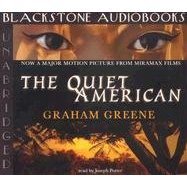
A couple weeks ago I faced a long drive by myself to Brock University in St. Catherine's, Ontario. To redeem the time as it were (6 hours each way), I checked out the audio version of Graham Greene's The Quiet American, read/performed by Joseph Porter. (Porter does a decent job, though his Alden Pyle sounds more like he's from Arkansas than Boston.)

This is Greene at his finest: an insightful critique of naive imperialisms in Indo-China forms the backdrop for the micro-drama between the "earnest" Protestantism of the American Pyle and the unwitting Catholicism of the "detached" Brit, Fowler, and their common love. Indeed, Love is at the center of everything, and the story is dripping with a sense of sacramental presence. The pentitential longing of the closing passage left me in tears on I-69.

The book also got me asking: Do we really have any great Protestant novelists? Can any Protestant novelist really hold a candle to the sacramental imaginations of Waugh, Greene, Percy, and O'Connor (or Tolkien)? What would we offer as a Protestant counterpart--Updike?! Is that the best we've got? Is this something of a confirmation of the "talking-head"-ness of Protestantism--its myopic concern with intellect as opposed to the Catholic affirmation of the sensual and imaginative?

3.16.2007

MacIntyre on NOT Having Your Cake and Eating It, Too

I'm spending some time in Alasdair MacIntyre's After Virtue today, and was particularly struck by the incisiveness of his diagnosis of a society that recognizes only "external" goods. As he discerns, "in any society which recognized only external goods, competitiveness would be the dominant and even exclusive feature" (p. 196). And then this fabulous quote:
Notoriously, the cultivation of truthfulness, justice and courage will often, the world being contingently what it is, bar us from being rich or famous or powerful.
The qualifier "contingently" is brilliant, and pregnant with theological insight: he doesn't given in to saying that these are always and essentially mutually exclusive, but only in the contingent configurations of our (broken, fallen) world. (It calls to mind some of Augustine's ruminations on "the praise of men" in Book 10 of the Confessions.)

MacIntyre then ends with this prescient diagnosis: "We should therefore expect that, if in a particular society the pursuit of external goods were to become dominant, the concept of the virtues might suffer first attrition and then perhaps something near total effacement, although simulacra might abound" (196).

Gee, I wonder what that sort of society might look like?

2.23.2007

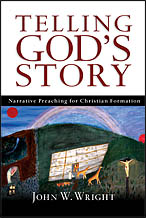
Telling God's Story: A must-read for preachers (and everybody else!)


I just had opportunity to read the manuscript for a book due out in May: Telling God's Story: Narrative Preaching for Christian Formation (InterVarsity Press). This is, hands-down, one of the best books I've read in months, and certainly the most exciting book I've ever read on preaching that actually thinks about the nature and task of the Church. (Imagine that: a book on homiletics that is actually tethered to ecclesiology and not just current trends in rhetoric or corporate sales strategies.) InterVarsity asked me to provide an endorsement for the book and I was glad to say the following:
The church should be worried about this book. It comes as an invitation to rethink the task of preaching, but three pages into it you’ll realize that Wright is not giving us another “how-to” book for adding to the plethora of “messages” delivered every Sunday. No, this little book is packed with minor prophet-like punch, arguing that preaching is the practice by which the North American church has fallen, but also gives us a glimpse of how preaching could help her stand. Providing a brilliant historical and theological diagnosis of the problem with so-called “biblically based, need-centered preaching” (whether liberal or conservative), Telling God’s Story winsomely sketches what authentic “biblical” preaching looks like: not conscripting the Bible to legitimate the cultural narratives of consumerist individualism or triumphant nationalism, but rather finding ourselves in the biblical story as an alternative to both. If the church is properly said to be a polis, then this book unpacks the “politics” of homiletics. It should be required reading in seminaries across the North America. And we could hope that pastors already immersed in ministry would be willing to risk reading this book. But be forewarned: it will radically change your understanding of your charge to “preach the Gospel.”

1.09.2007

The Bottom of the World

I'm not sure where this started--it might have been from reading Coleridge's Rime of the Ancient Mariner years ago, or perhaps Melville's Moby Dick, or maybe even watching Master and Commander--but for the last several years I've been fascinated with the seas off southern South America, and especially dipping below Cape Horn to the bottom of the world. Seas you can stroll beside in southern California are fine, but there must be a special kind of terrifying beauty about waters that can be so monstrous (I remember first sensing this watching the bay north of Vancouver).

So it was a special treat when a friend gave me a copy of Hal Roth's sailing memoir, Two Against Cape Horn (1978), which documents the voyage of Hal and Margaret Roth from southern California down the west coast to South America, through the coastal channels of Chile, and final around Cape Horn itself before heading home via the eastern seaboard. It is a remarkable tale, including vignettes of intriguing people, history of sailors who first ventured around the cape (including Darwin's voyage on the Beagle), creative frugality and learning to live off the gifts of land (wild celery) and sea (mussells everywhere)--and even the account of their own shipwreck which left them utterly dependend upon the hospitality of Chilean natives and the navy. That, perhaps, was one of the most intriguing aspects of the story. There is something about such lone voyages--like all of the lone adventures of the wealthy, whether climbing moutains or sailing around the world alone--which are the height of modern (and American) individualism, a John-Wayne-ish swagger of independence. Perhaps unwittingly, Roth's story shows this all to be a lie: nobody sails around the cape "alone."

1.03.2007

Kirk on Burke

As I've indicated at times over at Fors Clavigera, I have found myself of late sometimes struggling with my orientation--POLITICAL orientation, that is (though my wife is sometimes alarmed by my interest in Oscar Wilde!). While my soul recoils at the ideology of the Religious Right, I find myself equally disenchanted with the Religious Left, and so I myself drawn to earlier models--primarily the 19th-century Christian socialism of Ruskin, Maurice (and the less 'Christian' visions of William Morris), I have also had a growing interest in more classic "conservatism" (as opposed to the neo-conservatism that dominates today's political discourse). This is especially true since, as an advocate of "ancient" paths of catholicity, I'm clearly sympathetic with the anti-revolutionary streak that characterizes conservatism proper.

So a couple months ago, I thought I could kill two birds with one stone by reading Russell Kirk's biography of Edmund Burke: Edmund Burke: A Genius Reconsidered (1967; reprint ed., ISI Books, 1997). Burke is oft hailed as the father of conservatism, while Kirk is often looked to as a father of American conservatism. (The Russell Kirk Center is located not far from here, in Mecosta, MI.)

The book was a very engaging read, almost a bit of a page turner. It is written in a kind of "classical" style of brief biography (reminding me of Waugh's biography of Rossetti), perhaps teetering on the edge of hagiography, but never quite there. Kirk's treatment is primarily an account of the man through his ideas and political vocation, not pretending to offer any kind of comprehensive treatment. Rather, Kirk was trying to bring to life Burke's vision--and I was struck by how instructive it would be for today's neo-conservatives to return to Burke, who would have no truck with their passion for de-regulation, global expansion of laissez-faire market systems, and blatantly revolutionary program of "regime change."

Kirk's Burke is most passionately opposed to the "arbitrary" exercise of political power, which animated his attempts at conciliation with the American colonies while at the same time strenuously renouncing the French revolution and the ensuing reign of terror. This same concern led him to commit decades to reigning in the corruption of the East India Company and to battle for expanded Irish rights. This also translated into a very critical attitude to the Enlightenment (not unlike some postmodern critiques of the Enlighenment).

While I find Burke's penchant for Christendom to be bothersome, I can see where it's coming from (something like O'Donovan?). But what I find most perplexing about such "Christian" conservatism is how to square a core sensibility of conservatism with a core Christian doctrine. Conservatism, of course, is about "conserving;" it is anti-revolutionary, and operates with an abiding sense of the wisdom to be found in the past, in tradition, in the institutions that have been handed down across the ages. In fact, this translates into a kind of optimism about what's gone before. And it's this optimism about past institutions that I can't quite square with the doctrine of original sin. Burke at one point puts it this way, speaking in favor of "things long established": "The individual is foolish; the multitude, for the moment, is foolish, when they act without deliberation; but the species is wise, and when time is given to it, as a species, it almost always acts right" (p. 93).

But how to square this confidence in the native wisdom of "the species" with the trenchant critique of human wisdom as folly that we find in the New Testament (Rom. 1; 1 Cor. 1:18-25)? I wonder if there is grounds for an ecclesial conservatism but not a political conservatism.

In any case, this is a book that I will read again, sooner rather than later.

10.10.2006

Cormac McCarthy (Re)Visited

A while back I made an off-handed and second-hand comment about the "nihilism" of Cormac McCarthy. A thoughtful reader (from Australia, as I recall) sent an email and encouraged me to suspend judgment about McCarthy until I had actually read him. Sage advice. So this past summer, while I was in Pasadena, I picked up a first edition of All the Pretty Horses, the first volume of McCarthy's acclaimed "Border Trilogy."

This post is my confession: forgive me, for I have sinned. I am, without reservation and with much devotion, a new convert to a different McCarthyism--which is, for my money, a long ways from nihilism. All the Pretty Horses is one of the most enthralling books I have read in a long time. (In fact, as soon as I put it down I immediately went to eBay and scored first editions of the next two volumes in the trilogy.) The friendship between John Grady and Rawlins is one of the most beautiful and poignant I've encountered (though, I must confess, I found that images of Heath Ledger and Jake Gyllenhaal kept creeping into my head!). It is simply amazing how, in such sparse dialogue, McCarthy can make a friendship come to life so vividly. And far from nihilism, I did find in McCarthy what could be a kind of persistent hope--though, admittedly, it could also be a kind of resigned fatalism. But I'm suspending judgment until I work through the rest of the trilogy. And then hope to jump ahead to his newest novel, The Road. (Though that will take a while: I've tried to discipline myself to a bit of a reading order: a British novel, an American novel, then something "other" (e.g, French, Chinese), before moving back to British, American, etc. It's going to be hard to let those other McCarthy's sit on the shelf untouched.)

9.13.2006

Bird by Bird: Anne Lamott on Writing

[Despite a very busy summer, I also enjoyed a decent slate of summer reading, and will try to catch up a bit on my reading log here.]

Over the last two years my wife has become a devoted fan of Anne Lamott. Like most converts, she also tends to be a bit of a zealot, so I kept trying to more objectively guage just how good Anne Lamott was. While I still haven't gotten around to Traveling Mercies or Plan B, a few weeks ago while we were visiting friends in Atascadero, CA they gave me a copy of Lamott's Bird by Bird: Some Instructions on Writing and Life. I'm sold.

Lamott regularly had me laughing out loud. And if it doesn't sound too hokey, the book really was downright "inspiring." While I could pretty legitimately described as an "author," I still dream of being a "writer," and Lamott's wisdom helped dream myself into that just a little bit more. (Just need to take things "bird by bird.") But on top of the "instructions" side of this book, Lamott offers a number of gems by just being a closer observer, somebody who knows how to pay attention to what's right in front of her.

Perhaps, above all, I find her voice to be without guile. She is an honest writer, and here she is (sometimes brutally) honest about both writing and life.

8.13.2006

Wine, Interpretation, and "Objectivity"

An interesting piece in the New York Times today takes a hard look at the rise of the 100-point system for rating wine--tracing its history from Robert Parker's Wine Advocate to its industry-wide adoption--but also calling into question it's effectiveness. Even those who employ the system grant that it gives an air of scientificity and objectivity to something that is much slipperier and elusive. Judging wine (like hermeneutics and interpretation) is an art, not a science--though even the best art should be informed by good theory and criteria, as well as apprenticeship and training.

Perhaps most disheartening is the market-driven nature of the 100-point system and the challenges of conflict of interest when ratings are doled out by glossy magazines laced with ads from the wineries and producers subject to their judgment (as well as retailers who post those little scoring tags below the bottle displays). And while some mags commit [or claim to commit] to "blind" tasting, there's still a problem similar to peer-review in the academy: vintners have figured out what these folks like, and produce wines that are primed to score well--which is a bit like the tail wagging the dog.

The upshot? A few years ago, I read Jim Flick's book on golf, which recommended that most people should resist the hype of massive, ballooned 1-woods, just leave their drivers at home, play from the tee with a trusty 3-wood. Perhaps something of the same is true for new wine afficianados: Amateurs might do better to ignore the pseudo-science of scores and the mass-market formulas the system has spawned and, instead, trust the friendly, knowledgeable folks at a local wine shop.

8.03.2006

A Tale of Two Religions?

I had to hastily finish Michael Ruse's wonderful book The Creation-Evolution Struggle because it's due back to the public library. But it will repay a second loan. Ruse, a philosopher by training, has here written a bit of a page-turner history of the emergence of evolutionary theory and the ensuing debates and clash with religion--particularly creationism and intelligent design.

Ruse is eminently fair to both sides, without pulling any punches. It's particularly interesting to find a non-Christian scholar (Ruse variously describes himself as a "deist" and an "agnostic") who recognizes the long history of how legitimate evolutionary science is regularly morphed into a kind of secular religion. Ruse distinguishes these with the rubric of "evolution" or "evolutionary science" vs. "evolutionism"--the latter being the equivalent of a "secular religion." Ruse is at pains to argue that evolution did not necessarily entail evolutionism; but nevertheless, contingently and historically it did and has regularly yielded the latter.

Curiously, Ruse the philosopher here avoids properly philosohical questions (e.g., the epistemic conditions of "science," etc.), but he has addressed those questions elsewhere. This book provides an excellent history of the emergence of evolutionary theory and should be required reading for anyone interested in these questions.

7.24.2006

How We'll Read: The Future of the Book?

It would seem that the news of the death of the book has been a bit premature. While both prophets of doom and heralds of "progress" have been penning requiems for the book since the 1970s (sometimes falsely referring to Derrida's discussion of the "end of the book" in Of Grammatology), people still don't crawl into bed with Adobe eReaders and such.

However, a fascinating article in the Chronicle of Higher Education discussed some new initiatives in academic publishing: "Book 2.0" explores some projects related to the "Institute for the Future of the Book." While I'll never give up the tangibility of treasured hold-in-your-hand volumes of paper, I can see some interesting possibilities here for unique collaborative scholarship. Be sure to follow the links to "experience" the future of the book.

6.13.2006

(Another) American in Paris

Continuing an American tradition that goes back to Hemingway--and even earlier, as Franklin and Jefferson were regular haunts of the city--Adam Gopnik's Paris to the Moon is a memoir that narrates the five-year adventure of an American (and Canadian ex-pat) in Paris (1995-2000) with his wife, young son (and later a daughter that was the fruit of their time in the City of Light). This is one of those books that have been on my "to read" list since it was first released, but never made it onto the nightstand--due in no small part, I think, to just sheer jealousy. Gopnik was living the (my!) dream.

Making a commitment to reside in Paris, this isn't just another travelogue--though a persistent theme of the book is just how much he feels continues to feel like an outsider. The closest he ever feels to being an "insider" is when he becomes part of a protest group committed to keeping open a local restaurant in danger of being gobbled up by the homogenizing forces of globalizing cuisine. Connoisseurs of the world unite! But in the midst of their sit-in protest, Gopnik sees a problem with the revolution:
We were building up to an impressive pitch of indignation, but at that point the waiters began to serve the dinners that we had ordered while we were waiting to begin our protest, and this weakened the revolutionary spirit a little. There was, I sensed, a flaw in our strategy: If you take over a restaurant as an act of protest and then order dinner at the restaurant, what you have actually done is gone to the restaurant and had dinner, since a restaurant is, by definition, always occupied, by its diners. Having come to say that you just won't take it anymore, you have to add sheepishly that you will take it, au point and with bearnaise sauce.
The book is witty and warm, while also having the rather pedestrian virtue of being informative. Gopnik's chapters on French cuisine and couture are some of the best in the book for the way they respectfully and charitably peel back the layers of Paris for foreign eyes. His chronicles of the adventures of navigating French bureaucracy seethe with frustration, while the annals of a daily life lived in tiny, banal rituals provide a sense of the depth of the world. In these descriptions, the mundane habits of a walk in the park are seen as portals to hidden worlds--as if worlds upon worlds were tucked away in corners of the Luxembourg Gardens (found especially in the chapters that constitute his annual "Christmas Journals"--Journal 3, "Lessons from Things," being the best of the bunch).

Gopnik's pen is agile and tender, issuing in a flourish of similies ("Alice had found frisee and watercress and was looking at them raptly--not with the greed of a hungry man seeing dinner but with the admiration of William Bennett looking at a long marriage," p. 244) as well as on-the-money "capturings" of experience. My favorite in the latter category is when he describes storytime with his son, in the late evening:
Paris is a northern city, on a latitude with Newfoundland, as New York is a Mediterranean one, on a latitude with Naples, and so the light here in the hours between seven and nine at night is like the light in the hours between five and seven in New York. The sun is still out, but the sounds have become less purposeful--you hear smaller noises, high heels on the pavement--and though it is a pleasant time to lie in bed, it is not an easy time for a small boy to go to sleep (pp. 196-197).
The conjunction of light and sound, and the playful suggestion that the bend of the sun somehow dulls the air through which sound travels, crystallizes in the "high heels on the pavement" observation, which transports one to just that kind of evening and sound. Great stuff.

As is usual--one finds this alot with students who study abroad--the cross-cultural experience makes possible a reflection on one's own culture that wouldn't be possible otherwise. As Gopnik observes, "There are certain insights that can come to an American only when is abroad, because only there does the endless ribbon of American television become segmented enough so that you can pay attention to its parts," for instance. Gopnik is at his best in this mode of Paris-based reflection on American culture in his chapter "Barney in Paris" (yes, that Barney!) and some reflections on football (soccer) by a lover of baseball and hockey.

Gopnik's prose had so welcomed me into his world that I, too, felt the sting of his family's departure for Paris, just as I felt a sting of disappointment in the book's coming to an end.

5.14.2006

Best American Fiction?

The New York Times has an interesting piece on the best American fiction of the last 25 years. (For the implicit criteria, see the list of judges.) Toni Morrison's Beloved was the winner, and Don DeLillo's Underworld was runner-up (I don't think you'll see that one on Oprah's book club.) I'm not a huge fan of American fiction, but I do love Updike, and glad to see the Rabbit novels get honorary mention. And I just keep bumping into the nihilism of Cormac McCarthy everywhere, including a recent Harper's piece. Need to add his trilogy to my summer reading list.

5.13.2006

"Grace is Everywhere"

Those, like me, who enjoyed Marilynne Robinson’s Gilead will undoubtedly be moved by Georges Bernanos’ classic, The Diary of a Country Priest (first published in 1937), which I finished on the plane to Geneva. Indeed, one wonders if Robinson didn’t find a certain inspiration and model in Bernanos’ novel: Robinson gives us a glimpse into the epistolary legacy left by a dying old Reformed preacher in the rural American Midwest; Bernanos steals for us the diary of an ailing young Catholic priest tending a tiny parish in the French countryside.

The Diary is typically French: only about six things ever happen in the book. But the genius of the book is the anonymous priest’s keen observatory powers, turned on both his parish and friends, and turned inward in introspection. All of this is interlaced with brilliant literary theological reflection which seems to capture the spirit (I would say) of le nouvelle théologie. (E.g., the priest remarks: “Paganism was no enemy of nature, but Christianity alone can exalt it, can raise it to man’s own height, to the peak of his dreams.”)

His is an honest faith: grappling with doubt, and yet so strongly tethered to Christ; struggling with prayer, and yet a life bathed in prayer; looking for friendship, and finding it in the most unexpected places; loathing, but loving, his parishioners; frustrated by the institutional church, but not abandoning it. Above all, Bernanos illuminates the sacramentality of the world in the priest’s final words: “Grace is everywhere.”

4.13.2006

Laughing all the way to the Wodehouse

I just enjoyed the cathartic pleasures of some laugh-out-loud, tears-rolling-down humor in P.G. Wodehouse’s tales of Bertie Wooster and Jeeves--in a wonderful collection of Wodehouse’s witty short stories, The Most of P.G. Wodehouse (Scribner, 2000), which I picked up in Chicago a few weeks ago. A delightful change of pace from more sober reading of late.

Thinking back, I was put onto Wodehouse by two quite different trajectories that both intersect in Evelyn Waugh. The first was via Christopher Hitchens who, in Love, Poverty, and War, comments on both Waugh and Wodehouse. The second avenue was through the leads provided by George Weigel’s Letters to a Young Catholic, which also put me onto Waugh. Then, a couple months ago, on a gorgeous Saturday in early March, I sauntered over to a local used book shop (All the King’s Books) and found a wonderful collection on Waugh (Evelyn Waugh and His World, edited by David Pryce-Jones), which made several mentions of Wodehouse, including reference to Waugh’s defense of Woodhouse in the Times (16 July 1961). So when I ran into this Wodehouse collection in Chicago (and for a bargain!), it seemed as if Evelyn had led me to the spot. Tonight’s read was the pay-off.

4.03.2006

A Poem a Day

I'm enjoying a service that Knopf is providing as part of Poetry Month. Their "Poem-a-Day" list brings new poetry to your inbox each day--including both new voices and old favorites. Included are also podcasts of poem readings. For instance, today was a double treat: Joan Didion reading Gerard Manley Hopkins!

Amidst the administrative drudgery that constitutes most of my inbox, these little missives are like little in-breakings of grace from another world. Consider treating yourself to the same: subscription is free.

2.25.2006

John Paul II: A Call to Bishops

I just finished reading John Paul II's Rise, Let Us Be On Our Way (Warner Books, 2004)--a letter, of sorts, to fellow bishops. A quick and easy read, interesting both for matters of biography (the book roughly tracks the period after Wojtyla's ordination, focusing on his appointment as an auxilary bishop then bishop in Poland) and for reflections on the nature of the church, priesthood, and episcopate. It is also an invitation into the friendships that were so crucial to JP II's ministry (the array of Polish names gets pretty overwhelming). Especially interesting is the former Pope's discussion of his involvement with Vatican II, and then his task as bishop to "implement" the Council. Citing the importance of de Lubac for his thought, one finds in John Paul II's vision the kind of ancient-future sensibility which is able to think both ressourcement and aggiornamento. As he puts it near the end of the book (p. 213):

Our faith, our responsibility and our courage are all necessary if Christ's gift is to manifest itself to the world in all its splendor. Not just the kind of faith that safeguards and keeps intact the treasure of God's mysteries, but a faith that has the courage to open and reveal this treasure in constantly new ways to those to whom Christ sends His disciples. And not just the kind of responsibility that limits itself to defending what has been handed down, but the kind that has the courage to use its talents and multiply them.

While I continue to be nonplussed by JP II's tendency toward nationalisms and his friendliness to liberalism and capitalism (I can now see that this emerges from his experience with the atrocities of both the Nazis and Communists), this vision of an ancient-future Catholic faith that is unafraid to articulate a vision of the world to the world resonates deeply.