It's always a treat when voices that move, inspire, and evoke us come together on the same page of criticism: Who doesn't find an almost voyeuristic pleasure in reading living literary giants writing about other great contemporary literati? I'm a junkie for such criticism: reading Evelyn Waugh reviewing Graham Greene or P.G. Wodehouse, Joyce Carol Oates reviewing Don DeLillo--you get the idea. Those who enjoy the same intersections will find a treat in this Sunday's New York Times Book Review: Christopher Hitchens on John Updike's new non-fiction collection, Due Considerations. Not surprisingly, Hitch thinks Updike is just too damn nice.
As an aside, this is the sort of writing where Hitchens keeps his marbles. Unlike the sloppy "new atheist" Hitchens, Hitchens the literary critic--like Hitchens the investigative journalist--is always a delight.
11.02.2007
10.25.2007
Postal Petition from New York Review of Books
If, like me, you enjoy reading in literary and political magazines outside of the mainstreem, consider signing this petition:

On July 15, the postal rates for many of this nation's small magazines increased by 20 to 30 percent, due to a decision made by the Postal Regulatory Commission (PRC) that turns against more than 200 years of postal policy.
We believe this issue to be of such importance to small intellectual publications on both the right and left that we felt it imperative to alert our readers. This rate increase has the effect of shifting costs from the large publishers, such as Time Warner, to smaller publications, such as The New York Review, Commentary, The National Review, and The Nation. These unfair and onerous rate hikes threaten the future of many smaller, independent publications.
Congressional hearings have been scheduled for next Tuesday, October 30. Prior to that, we are requesting that all concerned readers sign a congressional email petition that can be found here: http://www.freepress.net/postal/
Free Press, working with a wide variety of small publishers, is hoping to collect well over 100,000 signatures by the end of this week in order to get the attention of the committee members prior to the hearing. We hope you will join in this effort. These new postal rates threaten the existence of the small independent magazines and journals that are so important to a free press and a vibrant democracy.
Thank you for your help.
Rea S. Hederman > Publisher

On July 15, the postal rates for many of this nation's small magazines increased by 20 to 30 percent, due to a decision made by the Postal Regulatory Commission (PRC) that turns against more than 200 years of postal policy.
We believe this issue to be of such importance to small intellectual publications on both the right and left that we felt it imperative to alert our readers. This rate increase has the effect of shifting costs from the large publishers, such as Time Warner, to smaller publications, such as The New York Review, Commentary, The National Review, and The Nation. These unfair and onerous rate hikes threaten the future of many smaller, independent publications.
Congressional hearings have been scheduled for next Tuesday, October 30. Prior to that, we are requesting that all concerned readers sign a congressional email petition that can be found here: http://www.freepress.net/postal/
Free Press, working with a wide variety of small publishers, is hoping to collect well over 100,000 signatures by the end of this week in order to get the attention of the committee members prior to the hearing. We hope you will join in this effort. These new postal rates threaten the existence of the small independent magazines and journals that are so important to a free press and a vibrant democracy.
Thank you for your help.
Rea S. Hederman > Publisher


10.02.2007
Pascal for our Time

I've been dipping back into an old love of late, Pascal's Pensees, in association with a (long overdue!) review I'm writing of William Desmond's very Pascalian Is There a Sabbath for Thought? Between Religion and Philosophy. So it was fortuitous when Nathan Bierma asked if I would write a little ode to Pascal for his Newsletter for the Christian Classics Ethereal Library (CCEL)--an immense resource of ancient, medieval and early modern texts. You can read it here.
8.28.2007
"Art of Fiction" Interviews from The Paris Review
On a rainy afternoon a couple weeks back, my wife and I curled up at Shuler's, a local bookstore. I found the latest issue of The Paris Review and was immediately sucked in by a fascinating interview with Norman Mailer, part of their "Art of Fiction" tradition of interviews with leading writers. Mailer is typically irreverent and spiritual at the same time, a kind of avant-garde conservative. The interview is a riot and filled with some absolute gems about matters including style, God, character development, wives and ex-wives ("every wife is a culture," Mailer remarks), the absence of a generation of critics to succeed Wilson, Kazin, and others--and much more. A wonderful read.
Today I went looking for the interview online (I couldn't quite afford to drop the twelve bucks for the journal) and found a veritable treasure trove: the journal has made available dozens and dozens of past "Art of Fiction" interviews since 1953. And they're being made available (many downloadable as .pdfs) absolutely free! A fantastic resource that will have me sidetracked for days.
Today I went looking for the interview online (I couldn't quite afford to drop the twelve bucks for the journal) and found a veritable treasure trove: the journal has made available dozens and dozens of past "Art of Fiction" interviews since 1953. And they're being made available (many downloadable as .pdfs) absolutely free! A fantastic resource that will have me sidetracked for days.
8.22.2007
Another Wright
I'm not sure what it is about this surname, but to my list of "favorite poets named Wright" (James, Franz), I have recently added Charles. I only recently encountered his work: first in the summer issue of the Virginia Quarterly Review, then, about a week later, on the new arrivals shelf at the Grand Rapids Public Library where I picked up his recent collection, Scar Tissue.
Wright does a wonderful job of capturing the colloquial in ways that honor it without making it "high falutin.'" I hear in him a chronicler of sides and spaces of American culture that don't often receive the attention of poetic homage. VQR very generously provides access to one of my favorites, "Cowboy Up" and "The Gospel According to Yours Truly."
Cowboy Up
Charles Wright
There comes a time in one’s life when one wants time,
a lot of time, with inanimate things.
Not ultimate inanimate things,
Of course, but mute things,
beautiful, untalkbackable wise things.
That’s wishful thinking, cowboy.
Still, I’d like to see the river of stars
fall noiselessly through the nine heavens for once,
But the world’s weight, and the world’s welter, speak big talk and
big confusion.
The Gospel According to Yours Truly
Charles Wright
Tell me again, Lord, how easy it all is—
renounce this,
Renounce that, and all is a shining—
Tell me again, I’m still here,
your quick-lipped and malleable boy.
(Strange how the clouds bump and grind, and the underthings roll,
Strange how the grasses finger and fondle each other—
I renounce them, I renounce them, I renounce them.
Gnarly and thin, the nothings don’t change . . .)
Wright does a wonderful job of capturing the colloquial in ways that honor it without making it "high falutin.'" I hear in him a chronicler of sides and spaces of American culture that don't often receive the attention of poetic homage. VQR very generously provides access to one of my favorites, "Cowboy Up" and "The Gospel According to Yours Truly."
Cowboy Up
Charles Wright
There comes a time in one’s life when one wants time,
a lot of time, with inanimate things.
Not ultimate inanimate things,
Of course, but mute things,
beautiful, untalkbackable wise things.
That’s wishful thinking, cowboy.
Still, I’d like to see the river of stars
fall noiselessly through the nine heavens for once,
But the world’s weight, and the world’s welter, speak big talk and
big confusion.
The Gospel According to Yours Truly
Charles Wright
Tell me again, Lord, how easy it all is—
renounce this,
Renounce that, and all is a shining—
Tell me again, I’m still here,
your quick-lipped and malleable boy.
(Strange how the clouds bump and grind, and the underthings roll,
Strange how the grasses finger and fondle each other—
I renounce them, I renounce them, I renounce them.
Gnarly and thin, the nothings don’t change . . .)
7.19.2007
Not Your Grandma's Christianity
I finally had an opportunity to read Lamin Sanneh's wonderful little book, Whose Religion is Christianity? The Gospel Beyond the West. Sanneh, of Yale, is one of the leading voices reminding Western & European Christianity that it doesn't "own" the Church. And the book is written in the very engaging format of a dialogue, which makes it almost breezy (why don't more of us adopt this strategy?).
The book is a very helpful corrective and antidote to those (like myself!) inclined to a dreamy notion of Catholic liturgy and orthodoxy as the panacea for all global ills. While Sanneh is very interested in considering how world Christianity contests the secularism of the West, the shape of this "counter"-narration is very different from Western and European Christian critiques of secularism (as in Radical Orthodoxy--though I also think there are some important resonances).
According to Sanneh, the most interesting explosion of world Christianity bears little genealogical relationship to colonial missionary endeavors (which gave us "global Christianity", the globalization of European Christianity, not "world" Christianity, which springs from the bottom up). Rather, the most interesting movements of Christianity in the global South are indigenous. However, the current explosion owes one important factor to western missionary endeavors: the translation of Scripture into the mother tongue for different global contexts. The result, according to Sanneh, was that once colonial presence withdrew from these regions, Africans (for instance) were free to encounter the Gospel as Africans because they had the Bible in their mother tongue. And according to Sanneh, these contexts were especially primed for the Gospel precisely because their indigenous and primal religious sensibilities made them open to the dynamics and enchantment of a creator God who would come to inhabit history, would suffer, and rise from the dead. In other words, primal religions functioned as an especially fertile and open horizon for the reception of the Gospel--but now "discovered" indigeneously, and thus not freighted with European colonial baggage.
This is a fascinating story, and Sanneh, though emphasizing indigenous Christianity, is not simplistically anti-European precisely because he sees their role in translation. (I think he would also have to concede the formative role of 'Western' Christianity in shaping the very shape of the canon of the Bible that would later be translated into these mother tongues--but perhaps, in fact, the formation of the canon already included African and Asian voices.)
I do worry that there remains a hint of a new Christendom project latent in this story, but nonetheless, it is a story that needs to be heard far and wide in the West.
The book is a very helpful corrective and antidote to those (like myself!) inclined to a dreamy notion of Catholic liturgy and orthodoxy as the panacea for all global ills. While Sanneh is very interested in considering how world Christianity contests the secularism of the West, the shape of this "counter"-narration is very different from Western and European Christian critiques of secularism (as in Radical Orthodoxy--though I also think there are some important resonances).
According to Sanneh, the most interesting explosion of world Christianity bears little genealogical relationship to colonial missionary endeavors (which gave us "global Christianity", the globalization of European Christianity, not "world" Christianity, which springs from the bottom up). Rather, the most interesting movements of Christianity in the global South are indigenous. However, the current explosion owes one important factor to western missionary endeavors: the translation of Scripture into the mother tongue for different global contexts. The result, according to Sanneh, was that once colonial presence withdrew from these regions, Africans (for instance) were free to encounter the Gospel as Africans because they had the Bible in their mother tongue. And according to Sanneh, these contexts were especially primed for the Gospel precisely because their indigenous and primal religious sensibilities made them open to the dynamics and enchantment of a creator God who would come to inhabit history, would suffer, and rise from the dead. In other words, primal religions functioned as an especially fertile and open horizon for the reception of the Gospel--but now "discovered" indigeneously, and thus not freighted with European colonial baggage.
This is a fascinating story, and Sanneh, though emphasizing indigenous Christianity, is not simplistically anti-European precisely because he sees their role in translation. (I think he would also have to concede the formative role of 'Western' Christianity in shaping the very shape of the canon of the Bible that would later be translated into these mother tongues--but perhaps, in fact, the formation of the canon already included African and Asian voices.)
I do worry that there remains a hint of a new Christendom project latent in this story, but nonetheless, it is a story that needs to be heard far and wide in the West.
7.05.2007
A Life in a Night: McEwan's On Chesil Beach

While, fittingly, on the beach, I finished Ian McEwan's latest, On Chesil Beach. Lingering in the ambiguous space between novella and novel, the book is exquisite. McEwan sketches worlds in fine-grained detail, but does so with a minimalist, almost sparse style. What I found most intriguing and remarkable, however, is his command of time. It is the rhythm and cadence of the novel that struck me. In the course of a focused, slice-of-life story about a wedding night, he also manages to narrate two complete lives. And he does so without having to resort to tricks or gimmicks like flashbacks. Instead, the story wends from past to present to future to present without missing a beat, and without the least jarring of the reader's temporal sensibilities. One of the summer's few "beach" reads that will repay re-reading.
6.01.2007
Repressing Freud
Gary Greenburg's fascinating Harper's article, "Manufacturing Depression" (May 2007) prompted me to take down off my shelf a volume with some dust on it: the Modern Library edition of The Basic Writings of Sigmund Freud. For the first time I read A.A. Brill's Introduction to the volume, which is both a pretty decent summary of Freud's psychoanalysis as well as Brill's recounting of his personal history with Freud--which coincides with the immigration of psychoanalysis to America, which was engineered by Brill as both Freud's first English translator and as founder of the New York Psychoanalytic Society. Freud recounts Brill's role in the final piece in this volume, "The History of the Psychoanalytic Movement." Freud was surprised by how well psychoanalysis was received "even in prudish America" (p. 950).
I finished Freud's "History" last night. While it is constructed as a bit of a martyr's tale, it is also an illuminating glimpse into the early debates. Especially helpful for me was Freud's account of the "seccession" of Jung who, on Freud's account, shrunk back from really being honest about the role of infantile sexuality in the development and formation of neuroses. Instead, Jung "spiritualizes" the libido. This, in fact, is a constant refrain in Freud: those who failed to follow his lead (also Breuler as well as Jung's "Swiss School") were too frightened to deal with the taboo of infantile sexuality. So Freud's "History of Psychoanalysis" is, in large part, a psychoanalysis of his opponents--which he freely admits, along with the risk (viz., that one opens oneself to a "psychoanalytic" response, p. 964). What surprised Freud is that someone could lose their psychoanalytic salvation: "I had not expected that anyone who had mastered analysis to a certain depth could renounce this understanding and lose it" (p. 963). With this sort of tone, I was almost waiting for the Master to break into parables about seeds, sowers, rocky ground, and birds of the air.
Whatever we have come to conclude about Freud (his theories are now roundly--and justly--criticized), I think we still need to appreciate how dramatic and powerful Freud's vision was. To read the work on dreams or sexuality is to see someone who is grappling with phenomena in incredibly attentive ways. In an almost phenomenological way, Freud was really attending to "the things themselves" (though like Husserl, he thought he was just "observing;" only his opponents he thought were "interpreting"). In sum, Freud articulated one of the most powerful and comprehensive mythologies of the last century. He sketched a nearly comprehensive story to account for phenomena that others had not.
In fact, what we have to deal with now is what Heidegger would call the "sedimentation" of theory. While Freud's theories have been discredited, psychoanalysis has sunked so deeply into the communal psyche of America that we end up constructing our experience according to Freudian rules. Thus "prudish America," heir to Puritanism and neo-puritanisms, is wont to repress so much, only to have it return. We thus end up replaying Freud in our everyday pathologies, even though we "know" better.
I finished Freud's "History" last night. While it is constructed as a bit of a martyr's tale, it is also an illuminating glimpse into the early debates. Especially helpful for me was Freud's account of the "seccession" of Jung who, on Freud's account, shrunk back from really being honest about the role of infantile sexuality in the development and formation of neuroses. Instead, Jung "spiritualizes" the libido. This, in fact, is a constant refrain in Freud: those who failed to follow his lead (also Breuler as well as Jung's "Swiss School") were too frightened to deal with the taboo of infantile sexuality. So Freud's "History of Psychoanalysis" is, in large part, a psychoanalysis of his opponents--which he freely admits, along with the risk (viz., that one opens oneself to a "psychoanalytic" response, p. 964). What surprised Freud is that someone could lose their psychoanalytic salvation: "I had not expected that anyone who had mastered analysis to a certain depth could renounce this understanding and lose it" (p. 963). With this sort of tone, I was almost waiting for the Master to break into parables about seeds, sowers, rocky ground, and birds of the air.
Whatever we have come to conclude about Freud (his theories are now roundly--and justly--criticized), I think we still need to appreciate how dramatic and powerful Freud's vision was. To read the work on dreams or sexuality is to see someone who is grappling with phenomena in incredibly attentive ways. In an almost phenomenological way, Freud was really attending to "the things themselves" (though like Husserl, he thought he was just "observing;" only his opponents he thought were "interpreting"). In sum, Freud articulated one of the most powerful and comprehensive mythologies of the last century. He sketched a nearly comprehensive story to account for phenomena that others had not.
In fact, what we have to deal with now is what Heidegger would call the "sedimentation" of theory. While Freud's theories have been discredited, psychoanalysis has sunked so deeply into the communal psyche of America that we end up constructing our experience according to Freudian rules. Thus "prudish America," heir to Puritanism and neo-puritanisms, is wont to repress so much, only to have it return. We thus end up replaying Freud in our everyday pathologies, even though we "know" better.
5.11.2007
Greene on the Rock
While over here in the UK I finished Graham Greene's Brighton Rock--set in the seaside resort town with a seedy side (think Atlantic City with accents), in the early 20th-century. It's a pretty streamlined treatment, and becomes quite brisk in the latter part of the story (one gets the feeling that Greene had a screen treatment in mind as he wrote the book--though it's clear that a film version could not have done justice to the closing drama and interiority). But what stands out is stunning character invention and development, particularly in the diabolical Pinkie, but also the self-confident Ida who, in a way, bears remarkable resemblance to the "earnestness" Alden Pyle in The Quiet American.
I won't be able to reproduce the layers of religious themes at work in the book, but perhaps a quote from the closing few pages captures how Greene sees sainthood tottering on the brink of demon possession (whereas Ida's world of moralistic certainty is actually never near to God). In the words of an anonymous priest:
Shivering thought.
I won't be able to reproduce the layers of religious themes at work in the book, but perhaps a quote from the closing few pages captures how Greene sees sainthood tottering on the brink of demon possession (whereas Ida's world of moralistic certainty is actually never near to God). In the words of an anonymous priest:
He said gently, 'Corruptio optimi est pessima.'
'Yes, father?'
'I mean--a Catholic is more capable of evil than anyone. I think perhaps--because we believe in Him--we are more in touch with the devil than other people.'
Shivering thought.
4.30.2007
Think Magic

Speaking of memoirs: after pointing me to Taylor's Leaving Church (and having the same concerns), my wife passed along Joan Didion's The Year of Magical Thinking (a National Book Award winner). In addition to Didion's literary depth, the book offers several other contrasts.
The year of "magical" thinking follows a horrific sequence at the end of 2003 in which Didion and her husband John Gregory Dunne find their daughter on life support. Returning home from one such excruciating visit, Dunne suffers a massive cardiac episode and dies. It is weeks before Didion's daughter regains consciousness and can be told the terrible news--only to then later suffer a brain bleed that once again puts her in a coma (she later, very slowly, recovers).
Both Taylor and Didion are Episcopalians, though Didion is forthright that this is merely a cultural tradition for her. She is Episcopalian in the same way that one might be Texan or speak Spanish: it is taken to be an accident of birth, though nonetheless a formative aspect of one's identity. But she confesses that her heart was never really in it when, at the end of the creed, she would profess belief in "the resurrection of the dead." And yet, the "magical" thinking of this year seems to be the hope that John will return: that things need to be primed for his re-appearance. But perhaps in describing this as "magical," Didion has already implanted all that's needed to dismiss such thinking as mad.
Ultimately this is a memoir of grieving; and by the end, she has begun the work of mourning. Indeed, one of the insights of the book is her experiential distinction between "grieving"--which is largely passive, comes in waves, and sneaks up on you--and "mourning"--which is active, requires hard work and intentionality. But despite being a memoir of grieving, one must be struck by how un-sentimental the book is: it almost has an air of aristocratic or royal restraint about it ("you mustn't let them see you weep"). And yet neither is it aloof or cold. It is forthright, honest, and heartbreaking.
What struck me most is the way in which The Year of Magical Thinking (unlike Leaving Church) is a memoir where characters other than the author really take center stage--in this case Didion's husband, John, and her daughter, Quintana. The memoir is an homage, without slipping into hagiography.
It is also a glimpse of what can only be described as an exotic, almost extinct beast: a 40-year marriage right smack in the middle of Hollywood and the New York literary set. Here was a couple who were both writers, who worked from home together pretty much everyday for 40 years, who not only survived this, but thrived because of it. It is this marriage and this friendship that makes The Year of Magical Thinking so lonely, veritably echoing with emptiness. What emerges from the book is an honest picture of a marriage that was, above all, a friendship in the most Aristotelian sense. The account of marriage here is one that puts to shame so much "Christian" literature (e.g., cp. the non-account of Taylor's marriage in her memoir, which seems so tangential to her identity). The Year of Magical Thinking is a story of marriage as the hardest thing in the world, but also the most rewarding and enlivening ("quickening" we would say in the older rhythms of King James English). As such, Didion gives unwitting, backhanded witness to sacramentality.
4.21.2007
Leaving Church for What?

I just finished Barbara Brown Taylor's "Memoir of Faith," Leaving Church. Taylor was for 20 years an Episcopal priest--first in an urban Atlanta parish, then moving to a rural north Georgia parish that calls to mind scenes from Mitford. The narrative arc of the memoir, however, recounts her decision to leave parish ministry--eventually ending up as a religion professor at Piedmont College. As such, the book is somewhat mistitled: it's really a book about leaving ordained ministry. "Leaving Clergy" would be more fitting, but less catchy--and it does seem by the end of the book that Taylor's post-clergy rendition of Christianity does translate into leaving church. Having so diffused God's presence into "the world"--especially the world of "nature"--Taylor can't come up with very good reasons for staying. So instead we find her on the porch of her hilltop home on Sunday mornings, reading the paper and enjoying the geese flying overhead. (Many "emergent" folks will find much that they'll love in her critique of the institutional church; that in itself is a red flag for me.) Taylor is clearly no Anglo-Catholic, since she sees no sense of any special presence of the Spirit in the church's sacraments.
The book is breezy and honest and a compelling read. As someone who has at times been tempted by the reverse trajectory--to "leave college" for ministry--the book is a sobering look behind the curtain which I'll want to keep close by whenever those temptations rear their ugly head.
But I must confess I never quite found myself sympathetic to Taylor's narrative voice. I think this is for at least two reasons:
First, I found the book incredibly self-absorbed. Someone might be quick to point, "Well, it is a memoir; what did you expect?" But perhaps this says something about what memoirs have become in our culture, and why there is such a cult of the memoir today--and increasingly within the church (I think the same voice comes across in the memoirs of Anne Lamott and Lauren Winner). The memoir is a symptom of the general cult of narcissism that characterizes late-modern American culture. In these memoirs, the author gets all the best lines. Indeed, I felt like Taylor voice sounded like that of the stereotypical "only child" (is she? I won't be at all surprised). The world painted for us revolves around Taylor, as if everything existed for Taylor.
Is it possible for memoirs to not be narcissistic? Absolutely, though they are rare today. A non-narcissistic memoir will be characterized by a first-person voice that doesn't confuse the first-person perspective with the centre of the universe. It will be a memoir that lets others emerge in full-bloom as developed characters, and puts the best lines in their mouths. (The paucity of other characters in the book was, for me, the most striking piece. Not even her husband's picture gets filled in.) In short, it would be a memoir characterized by one of St. Augustine's central axioms: "What do we have that we did not receive?" (1 Cor. 4:7)
My second reservation stems from the first: I just can't bring myself to find liberalism as a very interesting or viable hope for the future. And at the end of the day, Taylor just wants to give us more liberal Christianity. By "liberal" I don't mean an epithet that the Southern Baptist Convention throws at anyone who rejects a literal six-day creation. By "liberalism" I mean an understanding of the self and the world that was bequeathed to us by Locke and Rousseau--a vision that places the individual at the centre of the world and sees the entire world existing to satisfy that autonomous, self-determined individual.
And it seems that is the spirituality that Taylor finds liberating. She cites with approval another friend who "left church." Talking about his decision to no longer participate in the church's worship, the friend testified: "I think I finally hear the gospel. The good news of God in Christ is, 'You have everything you need to be human.' There is nothing oustide of you that you still need" (p. 219).
That might be a gospel, but it's not the Gospel of Jesus Christ--it's the gospel spewed by the evangelists of Enlightenment liberalism who waxed elegant about the self-sufficiency of the individual. A gospel of self-sufficiency is the antithesis of a gospel of grace, which points out our utter lack, and our utter dependence precisely on something outside ourselves. And not just God: the corporate worship of the church is itself a testimony to how much I need all of these odd, strange, generally unlikeable people that congregate together whether we "want" to or not.
As much as I would sometimes like to "leave church," I know that this would only be fueling the worst parts of me, allowing me to retreat to a comfy space that I control, no longer disciplined by the hard work of submitting to external discipline and no longer required to be called out of myself to encounter and love those who get on my nerves (and they me!).
Leaving church is easy; it's staying that requires courage--and that requires grace.
4.20.2007
Protestant Novelists?
I've been thinking a little more about the closing questions I offered in my earlier reflections on Graham Greene's Quiet American--my hunch that somehow the Catholic sacramental imagination has produced better novelists than the Protestant social imaginary.
I should have qualified this, of course, to say that I was thinking primarily of 20th-century novelists--which is why Updike came to mind. It's probably the case that any American novelist in the 20th-century who isn't Catholic is a kind of "Protestant" novelist by default, just because of the ubiquitous protestantism of American culture (somewhat like Hegel said all Western philosophy after Augustine is "Christian" philosophy in some sense). This is obviously the case for Hawthorne and Melville, but might still be the case for 20th-century novelists, at least up to the 60s or so.
Perhaps this line of questioning is untenable, but it does seem instructive somehow. Pen-pal acquaintance Andre Muller (New Zealand) articulated the issue in correspondence: what would it mean for a novel to be "Protestant?"
Well, probably lots of guilt, with no penance! In which case Cormac McCarthy might be the quintessential Protestant novelist (!). More specifically, it seems to me that "Protestant" novels tend toward a kind of didacticism that reflects the cognitivist, "talking-head" way that Protestantism has tended to construe Christian faith. So rather than the obliqueness of Greene, you get something like Marilynne Robinson's Gilead--which is a fabulous book, but not on the order of Waugh or O'Connor (in my humble opinion).
[P.S. While it is unfortunately not available online, those with access to a relatively good library might be interested in my piece on Franz Wright in the most recent Harvard Divinity Bulletin. It's entitled "Absence as a Window." The same issue includes new poems from Wright.]
I should have qualified this, of course, to say that I was thinking primarily of 20th-century novelists--which is why Updike came to mind. It's probably the case that any American novelist in the 20th-century who isn't Catholic is a kind of "Protestant" novelist by default, just because of the ubiquitous protestantism of American culture (somewhat like Hegel said all Western philosophy after Augustine is "Christian" philosophy in some sense). This is obviously the case for Hawthorne and Melville, but might still be the case for 20th-century novelists, at least up to the 60s or so.
Perhaps this line of questioning is untenable, but it does seem instructive somehow. Pen-pal acquaintance Andre Muller (New Zealand) articulated the issue in correspondence: what would it mean for a novel to be "Protestant?"
Well, probably lots of guilt, with no penance! In which case Cormac McCarthy might be the quintessential Protestant novelist (!). More specifically, it seems to me that "Protestant" novels tend toward a kind of didacticism that reflects the cognitivist, "talking-head" way that Protestantism has tended to construe Christian faith. So rather than the obliqueness of Greene, you get something like Marilynne Robinson's Gilead--which is a fabulous book, but not on the order of Waugh or O'Connor (in my humble opinion).
[P.S. While it is unfortunately not available online, those with access to a relatively good library might be interested in my piece on Franz Wright in the most recent Harvard Divinity Bulletin. It's entitled "Absence as a Window." The same issue includes new poems from Wright.]
4.06.2007
Graham Greene's "Very Quiet" American
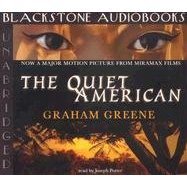
A couple weeks ago I faced a long drive by myself to Brock University in St. Catherine's, Ontario. To redeem the time as it were (6 hours each way), I checked out the audio version of Graham Greene's The Quiet American, read/performed by Joseph Porter. (Porter does a decent job, though his Alden Pyle sounds more like he's from Arkansas than Boston.)
This is Greene at his finest: an insightful critique of naive imperialisms in Indo-China forms the backdrop for the micro-drama between the "earnest" Protestantism of the American Pyle and the unwitting Catholicism of the "detached" Brit, Fowler, and their common love. Indeed, Love is at the center of everything, and the story is dripping with a sense of sacramental presence. The pentitential longing of the closing passage left me in tears on I-69.
The book also got me asking: Do we really have any great Protestant novelists? Can any Protestant novelist really hold a candle to the sacramental imaginations of Waugh, Greene, Percy, and O'Connor (or Tolkien)? What would we offer as a Protestant counterpart--Updike?! Is that the best we've got? Is this something of a confirmation of the "talking-head"-ness of Protestantism--its myopic concern with intellect as opposed to the Catholic affirmation of the sensual and imaginative?
3.16.2007
MacIntyre on NOT Having Your Cake and Eating It, Too
I'm spending some time in Alasdair MacIntyre's After Virtue today, and was particularly struck by the incisiveness of his diagnosis of a society that recognizes only "external" goods. As he discerns, "in any society which recognized only external goods, competitiveness would be the dominant and even exclusive feature" (p. 196). And then this fabulous quote:
MacIntyre then ends with this prescient diagnosis: "We should therefore expect that, if in a particular society the pursuit of external goods were to become dominant, the concept of the virtues might suffer first attrition and then perhaps something near total effacement, although simulacra might abound" (196).
Gee, I wonder what that sort of society might look like?
Notoriously, the cultivation of truthfulness, justice and courage will often, the world being contingently what it is, bar us from being rich or famous or powerful.The qualifier "contingently" is brilliant, and pregnant with theological insight: he doesn't given in to saying that these are always and essentially mutually exclusive, but only in the contingent configurations of our (broken, fallen) world. (It calls to mind some of Augustine's ruminations on "the praise of men" in Book 10 of the Confessions.)
MacIntyre then ends with this prescient diagnosis: "We should therefore expect that, if in a particular society the pursuit of external goods were to become dominant, the concept of the virtues might suffer first attrition and then perhaps something near total effacement, although simulacra might abound" (196).
Gee, I wonder what that sort of society might look like?
2.23.2007
Telling God's Story: A must-read for preachers (and everybody else!)
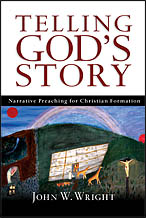
I just had opportunity to read the manuscript for a book due out in May: Telling God's Story: Narrative Preaching for Christian Formation (InterVarsity Press). This is, hands-down, one of the best books I've read in months, and certainly the most exciting book I've ever read on preaching that actually thinks about the nature and task of the Church. (Imagine that: a book on homiletics that is actually tethered to ecclesiology and not just current trends in rhetoric or corporate sales strategies.) InterVarsity asked me to provide an endorsement for the book and I was glad to say the following:
The church should be worried about this book. It comes as an invitation to rethink the task of preaching, but three pages into it you’ll realize that Wright is not giving us another “how-to” book for adding to the plethora of “messages” delivered every Sunday. No, this little book is packed with minor prophet-like punch, arguing that preaching is the practice by which the North American church has fallen, but also gives us a glimpse of how preaching could help her stand. Providing a brilliant historical and theological diagnosis of the problem with so-called “biblically based, need-centered preaching” (whether liberal or conservative), Telling God’s Story winsomely sketches what authentic “biblical” preaching looks like: not conscripting the Bible to legitimate the cultural narratives of consumerist individualism or triumphant nationalism, but rather finding ourselves in the biblical story as an alternative to both. If the church is properly said to be a polis, then this book unpacks the “politics” of homiletics. It should be required reading in seminaries across the North America. And we could hope that pastors already immersed in ministry would be willing to risk reading this book. But be forewarned: it will radically change your understanding of your charge to “preach the Gospel.”
1.09.2007
The Bottom of the World
I'm not sure where this started--it might have been from reading Coleridge's Rime of the Ancient Mariner years ago, or perhaps Melville's Moby Dick, or maybe even watching Master and Commander--but for the last several years I've been fascinated with the seas off southern South America, and especially dipping below Cape Horn to the bottom of the world. Seas you can stroll beside in southern California are fine, but there must be a special kind of terrifying beauty about waters that can be so monstrous (I remember first sensing this watching the bay north of Vancouver).
So it was a special treat when a friend gave me a copy of Hal Roth's sailing memoir, Two Against Cape Horn (1978), which documents the voyage of Hal and Margaret Roth from southern California down the west coast to South America, through the coastal channels of Chile, and final around Cape Horn itself before heading home via the eastern seaboard. It is a remarkable tale, including vignettes of intriguing people, history of sailors who first ventured around the cape (including Darwin's voyage on the Beagle), creative frugality and learning to live off the gifts of land (wild celery) and sea (mussells everywhere)--and even the account of their own shipwreck which left them utterly dependend upon the hospitality of Chilean natives and the navy. That, perhaps, was one of the most intriguing aspects of the story. There is something about such lone voyages--like all of the lone adventures of the wealthy, whether climbing moutains or sailing around the world alone--which are the height of modern (and American) individualism, a John-Wayne-ish swagger of independence. Perhaps unwittingly, Roth's story shows this all to be a lie: nobody sails around the cape "alone."
So it was a special treat when a friend gave me a copy of Hal Roth's sailing memoir, Two Against Cape Horn (1978), which documents the voyage of Hal and Margaret Roth from southern California down the west coast to South America, through the coastal channels of Chile, and final around Cape Horn itself before heading home via the eastern seaboard. It is a remarkable tale, including vignettes of intriguing people, history of sailors who first ventured around the cape (including Darwin's voyage on the Beagle), creative frugality and learning to live off the gifts of land (wild celery) and sea (mussells everywhere)--and even the account of their own shipwreck which left them utterly dependend upon the hospitality of Chilean natives and the navy. That, perhaps, was one of the most intriguing aspects of the story. There is something about such lone voyages--like all of the lone adventures of the wealthy, whether climbing moutains or sailing around the world alone--which are the height of modern (and American) individualism, a John-Wayne-ish swagger of independence. Perhaps unwittingly, Roth's story shows this all to be a lie: nobody sails around the cape "alone."
1.03.2007
Kirk on Burke
As I've indicated at times over at Fors Clavigera, I have found myself of late sometimes struggling with my orientation--POLITICAL orientation, that is (though my wife is sometimes alarmed by my interest in Oscar Wilde!). While my soul recoils at the ideology of the Religious Right, I find myself equally disenchanted with the Religious Left, and so I myself drawn to earlier models--primarily the 19th-century Christian socialism of Ruskin, Maurice (and the less 'Christian' visions of William Morris), I have also had a growing interest in more classic "conservatism" (as opposed to the neo-conservatism that dominates today's political discourse). This is especially true since, as an advocate of "ancient" paths of catholicity, I'm clearly sympathetic with the anti-revolutionary streak that characterizes conservatism proper.
So a couple months ago, I thought I could kill two birds with one stone by reading Russell Kirk's biography of Edmund Burke: Edmund Burke: A Genius Reconsidered (1967; reprint ed., ISI Books, 1997). Burke is oft hailed as the father of conservatism, while Kirk is often looked to as a father of American conservatism. (The Russell Kirk Center is located not far from here, in Mecosta, MI.)
The book was a very engaging read, almost a bit of a page turner. It is written in a kind of "classical" style of brief biography (reminding me of Waugh's biography of Rossetti), perhaps teetering on the edge of hagiography, but never quite there. Kirk's treatment is primarily an account of the man through his ideas and political vocation, not pretending to offer any kind of comprehensive treatment. Rather, Kirk was trying to bring to life Burke's vision--and I was struck by how instructive it would be for today's neo-conservatives to return to Burke, who would have no truck with their passion for de-regulation, global expansion of laissez-faire market systems, and blatantly revolutionary program of "regime change."
Kirk's Burke is most passionately opposed to the "arbitrary" exercise of political power, which animated his attempts at conciliation with the American colonies while at the same time strenuously renouncing the French revolution and the ensuing reign of terror. This same concern led him to commit decades to reigning in the corruption of the East India Company and to battle for expanded Irish rights. This also translated into a very critical attitude to the Enlightenment (not unlike some postmodern critiques of the Enlighenment).
While I find Burke's penchant for Christendom to be bothersome, I can see where it's coming from (something like O'Donovan?). But what I find most perplexing about such "Christian" conservatism is how to square a core sensibility of conservatism with a core Christian doctrine. Conservatism, of course, is about "conserving;" it is anti-revolutionary, and operates with an abiding sense of the wisdom to be found in the past, in tradition, in the institutions that have been handed down across the ages. In fact, this translates into a kind of optimism about what's gone before. And it's this optimism about past institutions that I can't quite square with the doctrine of original sin. Burke at one point puts it this way, speaking in favor of "things long established": "The individual is foolish; the multitude, for the moment, is foolish, when they act without deliberation; but the species is wise, and when time is given to it, as a species, it almost always acts right" (p. 93).
But how to square this confidence in the native wisdom of "the species" with the trenchant critique of human wisdom as folly that we find in the New Testament (Rom. 1; 1 Cor. 1:18-25)? I wonder if there is grounds for an ecclesial conservatism but not a political conservatism.
In any case, this is a book that I will read again, sooner rather than later.
So a couple months ago, I thought I could kill two birds with one stone by reading Russell Kirk's biography of Edmund Burke: Edmund Burke: A Genius Reconsidered (1967; reprint ed., ISI Books, 1997). Burke is oft hailed as the father of conservatism, while Kirk is often looked to as a father of American conservatism. (The Russell Kirk Center is located not far from here, in Mecosta, MI.)
The book was a very engaging read, almost a bit of a page turner. It is written in a kind of "classical" style of brief biography (reminding me of Waugh's biography of Rossetti), perhaps teetering on the edge of hagiography, but never quite there. Kirk's treatment is primarily an account of the man through his ideas and political vocation, not pretending to offer any kind of comprehensive treatment. Rather, Kirk was trying to bring to life Burke's vision--and I was struck by how instructive it would be for today's neo-conservatives to return to Burke, who would have no truck with their passion for de-regulation, global expansion of laissez-faire market systems, and blatantly revolutionary program of "regime change."
Kirk's Burke is most passionately opposed to the "arbitrary" exercise of political power, which animated his attempts at conciliation with the American colonies while at the same time strenuously renouncing the French revolution and the ensuing reign of terror. This same concern led him to commit decades to reigning in the corruption of the East India Company and to battle for expanded Irish rights. This also translated into a very critical attitude to the Enlightenment (not unlike some postmodern critiques of the Enlighenment).
While I find Burke's penchant for Christendom to be bothersome, I can see where it's coming from (something like O'Donovan?). But what I find most perplexing about such "Christian" conservatism is how to square a core sensibility of conservatism with a core Christian doctrine. Conservatism, of course, is about "conserving;" it is anti-revolutionary, and operates with an abiding sense of the wisdom to be found in the past, in tradition, in the institutions that have been handed down across the ages. In fact, this translates into a kind of optimism about what's gone before. And it's this optimism about past institutions that I can't quite square with the doctrine of original sin. Burke at one point puts it this way, speaking in favor of "things long established": "The individual is foolish; the multitude, for the moment, is foolish, when they act without deliberation; but the species is wise, and when time is given to it, as a species, it almost always acts right" (p. 93).
But how to square this confidence in the native wisdom of "the species" with the trenchant critique of human wisdom as folly that we find in the New Testament (Rom. 1; 1 Cor. 1:18-25)? I wonder if there is grounds for an ecclesial conservatism but not a political conservatism.
In any case, this is a book that I will read again, sooner rather than later.
10.10.2006
Cormac McCarthy (Re)Visited
A while back I made an off-handed and second-hand comment about the "nihilism" of Cormac McCarthy. A thoughtful reader (from Australia, as I recall) sent an email and encouraged me to suspend judgment about McCarthy until I had actually read him. Sage advice. So this past summer, while I was in Pasadena, I picked up a first edition of All the Pretty Horses, the first volume of McCarthy's acclaimed "Border Trilogy."
This post is my confession: forgive me, for I have sinned. I am, without reservation and with much devotion, a new convert to a different McCarthyism--which is, for my money, a long ways from nihilism. All the Pretty Horses is one of the most enthralling books I have read in a long time. (In fact, as soon as I put it down I immediately went to eBay and scored first editions of the next two volumes in the trilogy.) The friendship between John Grady and Rawlins is one of the most beautiful and poignant I've encountered (though, I must confess, I found that images of Heath Ledger and Jake Gyllenhaal kept creeping into my head!). It is simply amazing how, in such sparse dialogue, McCarthy can make a friendship come to life so vividly. And far from nihilism, I did find in McCarthy what could be a kind of persistent hope--though, admittedly, it could also be a kind of resigned fatalism. But I'm suspending judgment until I work through the rest of the trilogy. And then hope to jump ahead to his newest novel, The Road. (Though that will take a while: I've tried to discipline myself to a bit of a reading order: a British novel, an American novel, then something "other" (e.g, French, Chinese), before moving back to British, American, etc. It's going to be hard to let those other McCarthy's sit on the shelf untouched.)
This post is my confession: forgive me, for I have sinned. I am, without reservation and with much devotion, a new convert to a different McCarthyism--which is, for my money, a long ways from nihilism. All the Pretty Horses is one of the most enthralling books I have read in a long time. (In fact, as soon as I put it down I immediately went to eBay and scored first editions of the next two volumes in the trilogy.) The friendship between John Grady and Rawlins is one of the most beautiful and poignant I've encountered (though, I must confess, I found that images of Heath Ledger and Jake Gyllenhaal kept creeping into my head!). It is simply amazing how, in such sparse dialogue, McCarthy can make a friendship come to life so vividly. And far from nihilism, I did find in McCarthy what could be a kind of persistent hope--though, admittedly, it could also be a kind of resigned fatalism. But I'm suspending judgment until I work through the rest of the trilogy. And then hope to jump ahead to his newest novel, The Road. (Though that will take a while: I've tried to discipline myself to a bit of a reading order: a British novel, an American novel, then something "other" (e.g, French, Chinese), before moving back to British, American, etc. It's going to be hard to let those other McCarthy's sit on the shelf untouched.)
9.13.2006
Bird by Bird: Anne Lamott on Writing
[Despite a very busy summer, I also enjoyed a decent slate of summer reading, and will try to catch up a bit on my reading log here.]
Over the last two years my wife has become a devoted fan of Anne Lamott. Like most converts, she also tends to be a bit of a zealot, so I kept trying to more objectively guage just how good Anne Lamott was. While I still haven't gotten around to Traveling Mercies or Plan B, a few weeks ago while we were visiting friends in Atascadero, CA they gave me a copy of Lamott's Bird by Bird: Some Instructions on Writing and Life. I'm sold.
Lamott regularly had me laughing out loud. And if it doesn't sound too hokey, the book really was downright "inspiring." While I could pretty legitimately described as an "author," I still dream of being a "writer," and Lamott's wisdom helped dream myself into that just a little bit more. (Just need to take things "bird by bird.") But on top of the "instructions" side of this book, Lamott offers a number of gems by just being a closer observer, somebody who knows how to pay attention to what's right in front of her.
Perhaps, above all, I find her voice to be without guile. She is an honest writer, and here she is (sometimes brutally) honest about both writing and life.
Over the last two years my wife has become a devoted fan of Anne Lamott. Like most converts, she also tends to be a bit of a zealot, so I kept trying to more objectively guage just how good Anne Lamott was. While I still haven't gotten around to Traveling Mercies or Plan B, a few weeks ago while we were visiting friends in Atascadero, CA they gave me a copy of Lamott's Bird by Bird: Some Instructions on Writing and Life. I'm sold.
Lamott regularly had me laughing out loud. And if it doesn't sound too hokey, the book really was downright "inspiring." While I could pretty legitimately described as an "author," I still dream of being a "writer," and Lamott's wisdom helped dream myself into that just a little bit more. (Just need to take things "bird by bird.") But on top of the "instructions" side of this book, Lamott offers a number of gems by just being a closer observer, somebody who knows how to pay attention to what's right in front of her.
Perhaps, above all, I find her voice to be without guile. She is an honest writer, and here she is (sometimes brutally) honest about both writing and life.
8.13.2006
Wine, Interpretation, and "Objectivity"
An interesting piece in the New York Times today takes a hard look at the rise of the 100-point system for rating wine--tracing its history from Robert Parker's Wine Advocate to its industry-wide adoption--but also calling into question it's effectiveness. Even those who employ the system grant that it gives an air of scientificity and objectivity to something that is much slipperier and elusive. Judging wine (like hermeneutics and interpretation) is an art, not a science--though even the best art should be informed by good theory and criteria, as well as apprenticeship and training.
Perhaps most disheartening is the market-driven nature of the 100-point system and the challenges of conflict of interest when ratings are doled out by glossy magazines laced with ads from the wineries and producers subject to their judgment (as well as retailers who post those little scoring tags below the bottle displays). And while some mags commit [or claim to commit] to "blind" tasting, there's still a problem similar to peer-review in the academy: vintners have figured out what these folks like, and produce wines that are primed to score well--which is a bit like the tail wagging the dog.
The upshot? A few years ago, I read Jim Flick's book on golf, which recommended that most people should resist the hype of massive, ballooned 1-woods, just leave their drivers at home, play from the tee with a trusty 3-wood. Perhaps something of the same is true for new wine afficianados: Amateurs might do better to ignore the pseudo-science of scores and the mass-market formulas the system has spawned and, instead, trust the friendly, knowledgeable folks at a local wine shop.
Perhaps most disheartening is the market-driven nature of the 100-point system and the challenges of conflict of interest when ratings are doled out by glossy magazines laced with ads from the wineries and producers subject to their judgment (as well as retailers who post those little scoring tags below the bottle displays). And while some mags commit [or claim to commit] to "blind" tasting, there's still a problem similar to peer-review in the academy: vintners have figured out what these folks like, and produce wines that are primed to score well--which is a bit like the tail wagging the dog.
The upshot? A few years ago, I read Jim Flick's book on golf, which recommended that most people should resist the hype of massive, ballooned 1-woods, just leave their drivers at home, play from the tee with a trusty 3-wood. Perhaps something of the same is true for new wine afficianados: Amateurs might do better to ignore the pseudo-science of scores and the mass-market formulas the system has spawned and, instead, trust the friendly, knowledgeable folks at a local wine shop.
Subscribe to:
Posts (Atom)


 Posts
Posts


